Skip to content

What Does Physiotherapy for TMJ Involve?
If you have jaw pain, clicking, locking, headaches, or pain near the ear, you may have been told it could be related to your TMJ. But many people are not sure what physiotherapy for TMJ actually involves.
TMJ physiotherapy is not just massage around the jaw. A good assessment looks at how the jaw joint, disc, muscles, neck, tongue, breathing, habits, and movement patterns are working together. The goal is to understand what is driving your symptoms and build a plan that helps your jaw move more comfortably.
At Avenue Physio, our physiotherapists have additional training and experience in assessing and treating TMJ, jaw, and neck conditions. We look at the whole system, not just the painful spot.
TMJ Care Is More Than Treating the Joint
TMJ symptoms are rarely caused by one structure alone. The joint and disc can matter, but so can the jaw muscles, neck mobility, deep neck control, tongue position, breathing, sleep, stress, clenching habits, and overall sensitivity.
The TMJ is a small but complex joint. It has to rotate, glide, absorb load, and coordinate movement on both sides every time you open your mouth, chew, speak, yawn, or swallow. Because of this, treatment should not focus only on “putting the joint back in place” or releasing one tight muscle.
A good physiotherapy assessment looks at how the jaw and neck are moving, how the muscles are loading, how the tongue and jaw rest during the day, and what habits may be keeping the area irritated.
What Is the TMJ?
The temporomandibular joint, or TMJ, connects your jawbone to your skull. You have one TMJ on each side, just in front of each ear.
The TMJ is unique because the jaw works through two joints at the same time. When you first open your mouth, the jaw starts with a hinge-like movement. As you open further, the joint also needs to glide forward. Both sides have to coordinate together for the jaw to open smoothly.
Each TMJ contains a small articular disc. This disc helps the joint move smoothly, absorb load, and guide movement. Disc changes, including clicking, do not always mean damage. Some people have painless clicking and normal function, and they may not need treatment at all.
Because the TMJ is closely connected to the neck, face, head, tongue, and upper body, treatment often needs to look beyond the joint itself.
What Symptoms Can TMJ Physiotherapy Help With?
TMJ physiotherapy may help when symptoms are related to the jaw joint, jaw muscles, neck, or movement control.
Common symptoms include:
- jaw pain
- clicking or popping
- locking or catching
- pain near the ear
- pain with chewing or talking
- jaw stiffness
- facial tension
- headaches or temple pain
- neck pain or upper shoulder tension
- clenching or grinding-related symptoms
- difficulty opening the mouth fully
Not every jaw symptom needs treatment. Some people have painless clicking that does not affect chewing, speaking, or daily life. Physiotherapy becomes more relevant when symptoms are painful, limiting, persistent, or affecting normal function.
Step 1: Understanding Your Story
The first part of a TMJ assessment is understanding your story.
Your physiotherapist will ask about:
- where you feel pain
- when symptoms started
- whether symptoms came on gradually or after an injury
- what makes symptoms better or worse
- whether chewing, yawning, talking, or clenching aggravates symptoms
- whether your jaw clicks, catches, or locks
- whether you have headaches, neck pain, ear pressure, or facial tension
- whether symptoms are worse in the morning or later in the day
- sleep, stress, work habits, dental history, and previous treatment
These questions matter because TMJ symptoms are often multifactorial. The issue may not be one single structure. It may be the joint, disc, muscles, neck, clenching habits, load tolerance, sensitivity, or a combination of factors.
Step 2: Assessing Jaw Movement
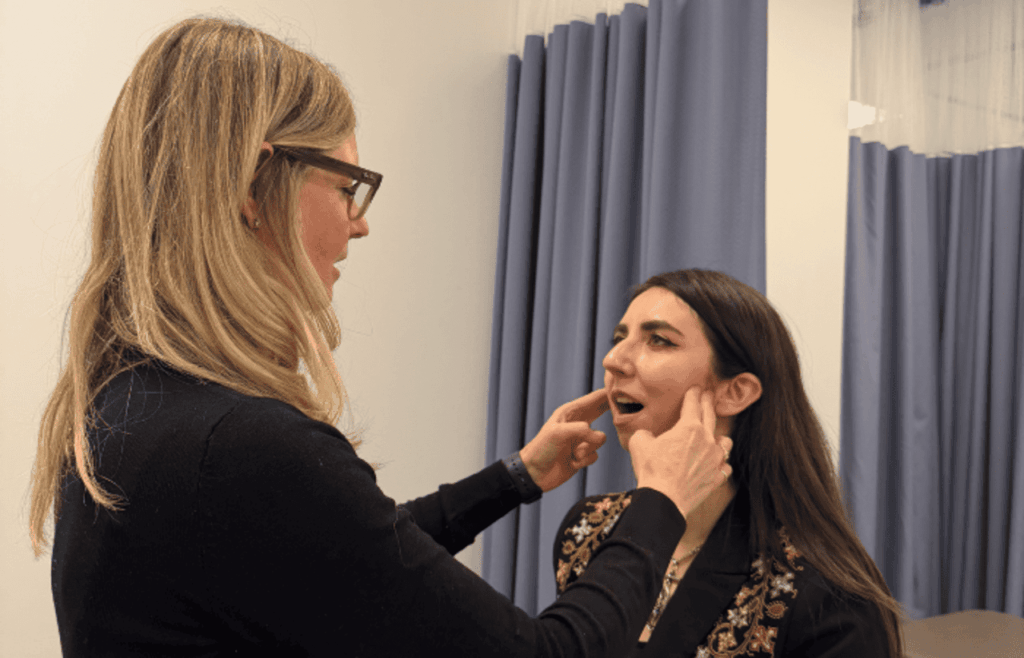
A TMJ assessment includes looking at how your jaw moves.
Your physiotherapist may assess:
- how far your jaw opens
- whether opening is painful
- whether the jaw moves straight or shifts to one side
- whether there is clicking, popping, catching, or locking
- how the jaw moves when opening, closing, protruding, or moving side to side
- whether symptoms change with different jaw positions
This helps determine whether the issue is more related to joint mobility, disc mechanics, muscle tension, movement coordination, or sensitivity.
For example, a jaw that shifts to one side during opening may suggest that one side is moving differently than the other. Pain with resisted movements may point more toward muscle involvement. Clicking may suggest altered disc and joint coordination, but clicking alone does not necessarily mean damage.
Step 3: Assessing the Jaw Muscles
The jaw muscles are often a major part of TMJ symptoms.
Your physiotherapist may assess tenderness and tone in muscles such as:
- masseter
- temporalis
- lateral pterygoid region
- muscles under the jaw
- upper neck and throat-related muscles
These muscles can become sensitive from clenching, grinding, chewing load, stress, poor sleep, or protective muscle tension.
The masseter can refer pain into the cheek, jawline, teeth, and ear region. The temporalis can refer pain into the temple, forehead, and teeth. Deeper muscles such as the pterygoids can influence jaw movement, disc mechanics, and pain around the joint.
This is why TMJ treatment often includes muscle work, but it should not stop there.
Step 4: Assessing the Neck, Shoulders, and Upper Back
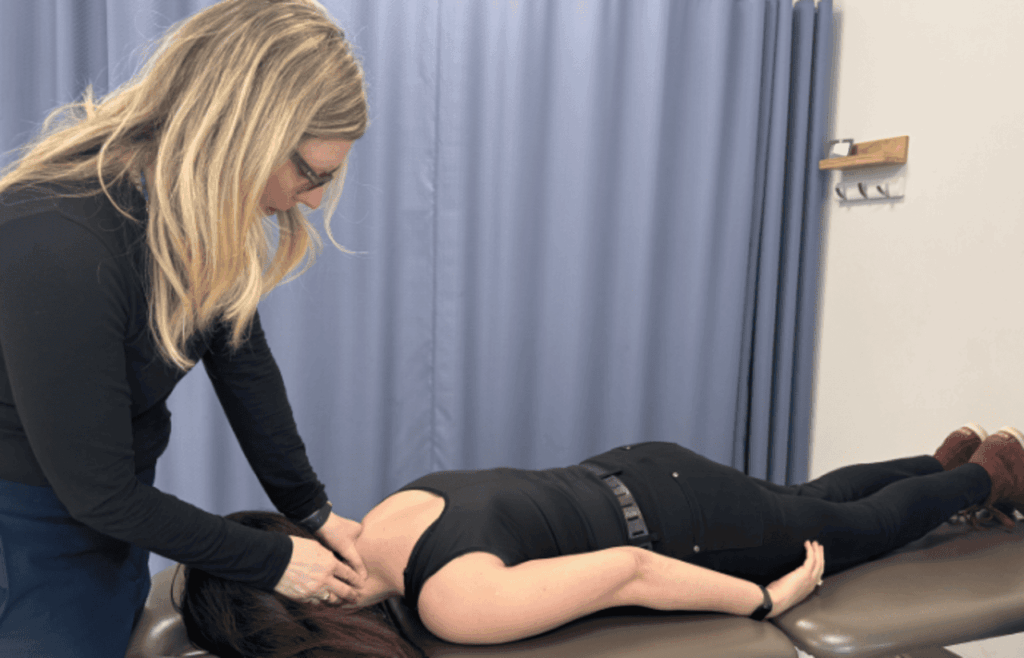
A good TMJ assessment should include the neck.
The jaw and neck are closely connected through joints, muscles, nerves, and movement patterns. The upper neck helps control head position, and head position can influence jaw movement. The jaw and neck also share overlapping nerve pathways, which is one reason jaw problems can be felt as headaches, temple pain, ear symptoms, or upper neck tension.
Your physiotherapist may assess:
- upper neck mobility
- neck range of motion
- deep neck flexor control
- posture and head position
- upper back mobility
- tenderness in the neck and shoulder muscles
- whether neck movements reproduce or change symptoms
The deep muscles at the front of the neck help provide stability and control for the head and neck. When this system is not providing enough stability, the jaw, throat, and larger neck muscles may start working harder than they need to. Over time, this can create a pattern where the jaw and neck keep feeding into each other.
We may also look at the shoulders and upper back, because the jaw does not sit on its own. Muscles such as the upper trapezius, levator scapulae, sternocleidomastoid, and suboccipitals can all influence head and neck position. If the upper back and shoulder girdle are stiff, tense, or not providing good support, the neck may work harder, which can feed into jaw tension, headaches, or TMJ symptoms.
Step 5: Understanding Habits and Load
TMJ symptoms are often influenced by the total load on the jaw.
That load may come from:
- clenching
- grinding
- chewing tough foods
- gum chewing
- nail biting
- prolonged talking
- stress-related jaw tension
- poor sleep
- long periods of computer work
- holding tension in the jaw, neck, or shoulders
This does not mean your symptoms are “just stress.” It means your jaw may be spending too much time under load without enough recovery.
A helpful part of physiotherapy is identifying which daily habits are keeping the area sensitive and which changes are realistic for you.
The Tongue and Resting Jaw Position Matter Too
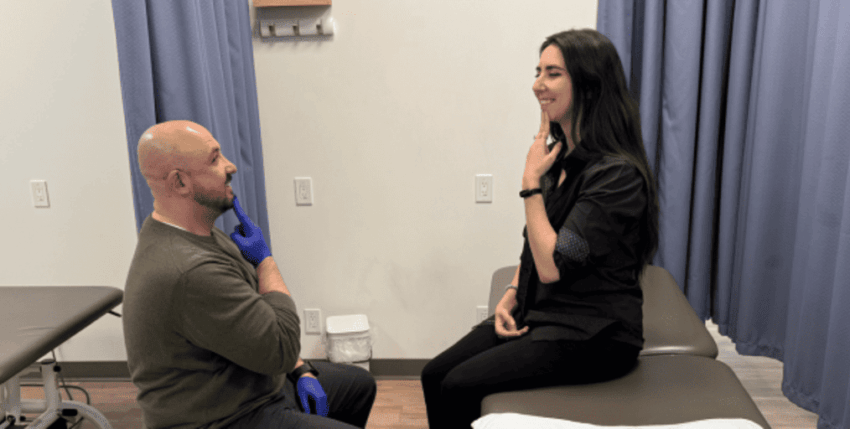
The tongue plays an important role in jaw comfort and control. At rest, the jaw should not be held tightly closed. Ideally, the lips can rest together, the teeth stay slightly apart, and the tongue rests gently against the roof of the mouth.
This position helps reduce unnecessary tension through the jaw muscles. If the teeth are often touching during the day, even lightly, the jaw muscles may be working more than they need to. Over time, that can contribute to muscle fatigue, facial tension, headaches, or jaw pain.
Tongue position can also influence breathing, swallowing, and how the jaw moves. For some people, retraining resting tongue position and jaw relaxation is an important part of reducing load on the TMJ.
A simple cue many people find helpful is:
Lips together, teeth apart, tongue resting gently on the roof of the mouth.
This is not about forcing the jaw into a perfect position. It is about helping the jaw spend more time in a relaxed, unloaded state.
Step 6: Treatment Is Based on What Is Driving the Problem
There is no single TMJ treatment that works for everyone.
Some people need help reducing muscle sensitivity. Others need to improve jaw coordination, neck mobility, or deep neck control. Some need strategies for clenching, grinding, flare ups, or gradually reintroducing normal chewing.
Treatment may include hands-on therapy, dry needling or IMS when muscle sensitivity is a significant contributor, education, movement retraining, exercises, habit strategies, and a plan for self-management.
The goal of TMJ physiotherapy is not simply to “release” the jaw. The goal is to understand why the jaw is sensitive, restore comfortable movement, and give you a clear plan to manage symptoms in daily life.
Step 7: Hands-On Treatment May Help
Hands-on treatment can be helpful for some people with TMJ symptoms.
Depending on your assessment, treatment may include:
- gentle joint mobilization
- soft tissue treatment to the jaw muscles
- treatment to the neck and upper back
- work around the masseter and temporalis
- techniques to help reduce muscle guarding and improve movement comfort
Some TMJ treatment may involve work inside the mouth, but only when appropriate and only with clear explanation and consent. Intraoral treatment is not always needed, and it should never feel rushed or forced.
The purpose of hands-on treatment is to help reduce sensitivity, improve movement, and make exercises or daily activities feel more manageable.
Step 8: IMS or Dry Needling May Be Considered
IMS or dry needling may be helpful for some people with TMJ-related symptoms, especially when muscle sensitivity, guarding, or overload is part of the problem.
The jaw and neck muscles can become sensitive from clenching, grinding, stress, poor sleep, prolonged talking, or protective tension around the joint. In some cases, dry needling may be used to help calm sensitive muscles, reduce tension, and make it easier to retrain comfortable movement.
Dry needling is not required for everyone with TMJ symptoms, and it is not a stand-alone fix. It is best used when it fits the assessment findings and is combined with education, movement retraining, exercises, and strategies to reduce load on the jaw.
At Avenue Physio, your physiotherapist will discuss whether IMS or dry needling is appropriate for you and explain what to expect before treatment.
Step 9: Exercises and Movement Retraining
Exercises are an important part of TMJ physiotherapy.
These may include:
- controlled jaw opening and closing
- jaw tracking exercises
- tongue resting position and relaxed jaw posture
- controlled jaw opening with the tongue gently resting on the roof of the mouth
- breathing and relaxation strategies
- deep neck flexor exercises
- neck mobility exercises
- postural endurance work
- gentle strengthening when appropriate
The goal is not to overload the jaw. The goal is to improve control, coordination, mobility, and confidence.
For many people, small, consistent exercises work better than aggressive stretching or forcing the jaw open.
Step 10: Education and Flare-Up Management
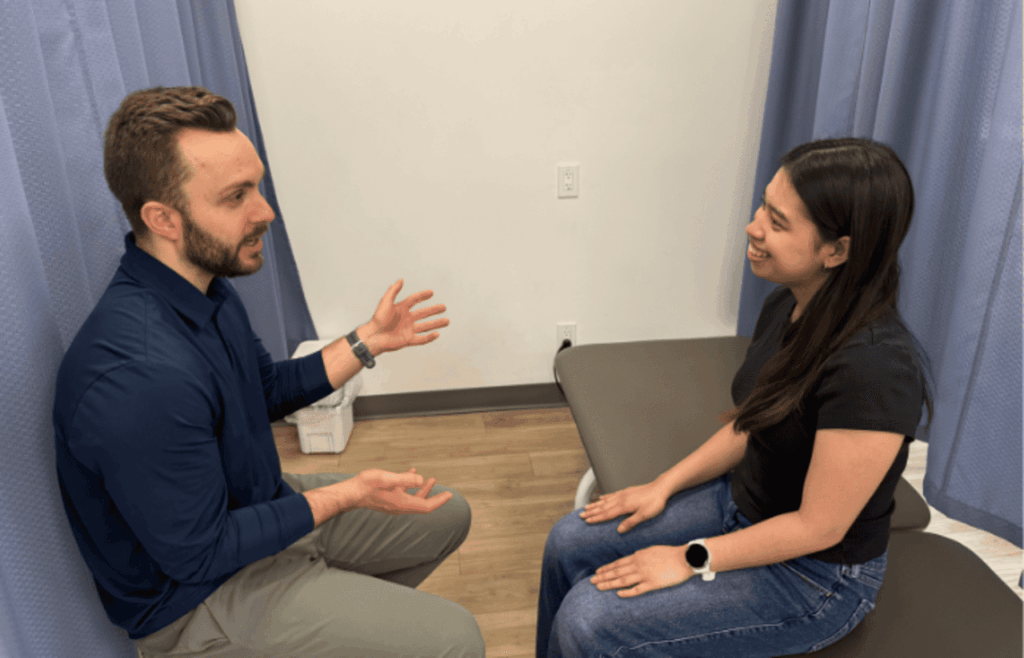
Education is one of the most important parts of TMJ care.
Your physiotherapist should help you understand:
- what is likely contributing to your symptoms
- what symptoms mean and what they do not mean
- whether clicking is something to monitor or treat
- how to modify chewing or jaw load temporarily
- how to manage flare ups
- how sleep, stress, posture, and clenching may influence symptoms
- when to involve a dentist, physician, orthodontist, or other provider
This helps reduce fear and gives you a clearer plan.
What About Clenching and Grinding?
Clenching and grinding are common contributors to TMJ symptoms.
Physiotherapy cannot stop all nighttime grinding, and sometimes a dentist may need to be involved, especially if tooth wear, bite guards, or dental concerns are present.
But physiotherapy can help by addressing:
- jaw and neck muscle tension
- daytime clenching habits
- jaw resting position
- movement control
- neck contribution
- strategies to reduce load on the jaw
For many people, becoming aware of daytime clenching is a major first step. A helpful cue is: lips together, teeth apart, tongue resting gently on the roof of the mouth.
What About Botox for TMJ?
Some people with TMJ symptoms are told about Botox, especially when clenching, grinding, or jaw muscle overactivity is part of the picture. Botox may be considered in some cases, but it is a medical treatment and is not provided as part of physiotherapy.
Physiotherapy focuses on understanding why the jaw is sensitive, how the jaw and neck are moving, and what habits or loads may be keeping symptoms irritated. This may include education, jaw and neck treatment, movement retraining, strategies for clenching, and exercises to improve control and comfort.
For some people, Botox may be discussed with a physician, dentist, or other qualified medical provider. Physiotherapy can still play an important role by addressing the movement, muscle, neck, and habit-related factors that may be contributing to the problem.
How Long Does TMJ Physiotherapy Take?
The timeline depends on what is contributing to your symptoms.
Some people notice improvement within a few weeks, especially when symptoms are mostly muscle-related or aggravated by specific habits. More persistent symptoms, locking, long-term clenching, headaches, or neck involvement may take longer.
The goal is not just short-term relief. The goal is to improve how the jaw and neck function so symptoms are less likely to keep flaring.
When Should Other Providers Be Involved?
TMJ care is often best when it is collaborative.
Your physiotherapist may recommend involving a dentist, physician, orthodontist, or specialist if there are signs of:
- significant dental pain
- tooth wear from grinding
- bite changes
- trauma
- unexplained swelling
- infection-like symptoms
- hearing changes
- neurological symptoms
- persistent locking
- symptoms that are not responding as expected
A good physiotherapist should know when to treat and when to refer.
The Bottom Line
Physiotherapy for TMJ should be more than a quick jaw massage. A thorough approach looks at the jaw joint, disc, muscles, neck, posture, breathing, habits, and daily load.
Treatment may include hands-on therapy, dry needling or IMS when appropriate, education, movement retraining, exercises, habit strategies, and self-management.
The goal is to understand what is driving your symptoms and help your jaw and neck move more comfortably again.
Need Help With TMJ Pain, Clicking, or Jaw Tension?
At Avenue Physio, our physiotherapists have additional training and experience in TMJ, jaw, and neck care. We take a one-on-one, whole-system approach to help you understand your symptoms and build a clear treatment plan.
Book your TMJ assessment to get started.