Skip to content

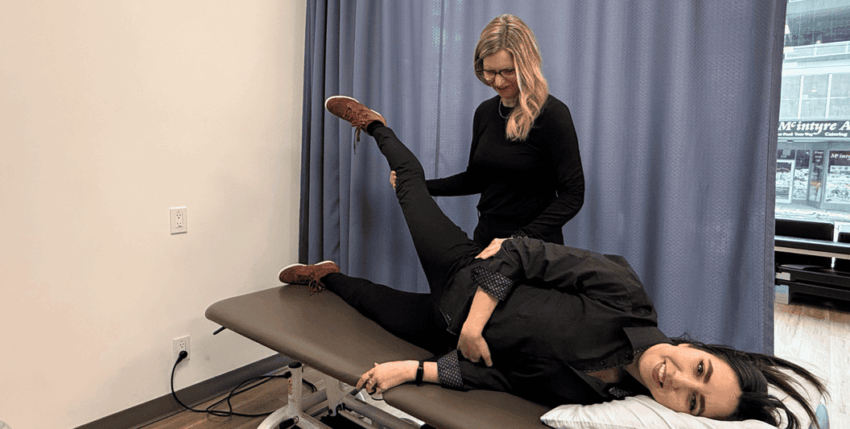
What Causes Hip Pain? Common Causes and How Physiotherapists Diagnose It
Hip pain can have many different causes, and figuring out which one is responsible isn’t always as simple as pointing to where it hurts.
Pain in the groin may come from the hip joint, but it can also involve muscles or tendons around the hip. Pain on the outside of the hip may be related to the gluteal tendons and surrounding structures. Pain in the buttock may actually be coming from the lower back rather than the hip at all.
So how do we tell the difference?
We start by looking for patterns. Where you feel the pain, how it started, what aggravates it, how your hip moves, what happens when we load different muscles and tendons, and how the problem is affecting your everyday activities all provide clues.
No single symptom or test usually gives us the answer. Instead, we put those findings together to determine which diagnosis best fits your presentation and, just as importantly, what needs to be addressed to help you recover.
That is what a thorough physiotherapy assessment is designed to do.
Where Is Your Hip Pain?
One of the first questions we ask is surprisingly simple:
Where do you feel it?
Hip pain is often described in three general areas: the front of the hip or groin, the outside of the hip, or the buttock and back of the hip.
Where you hurt can immediately begin to narrow down the possibilities, but it is only the first clue. From there, we look at the rest of the story to determine what fits and what doesn’t.
Pain in the Front of the Hip or Groin
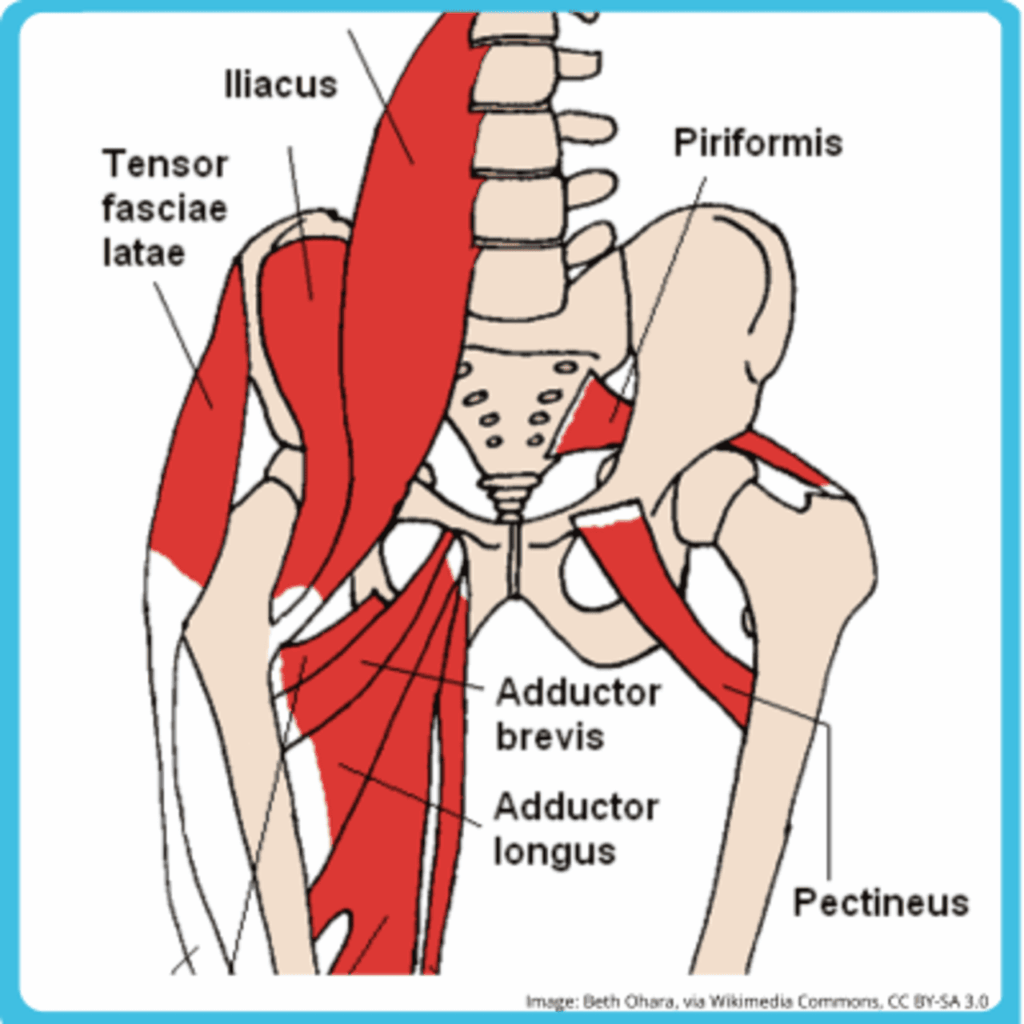
Pain felt deep in the groin or at the front of the hip often makes us consider the hip joint itself, although muscles, tendons and other structures in the area can also produce pain.
Hip Osteoarthritis
Hip osteoarthritis commonly causes pain in the groin or front of the hip, although pain can also be felt in the thigh and sometimes even the knee.
People may notice gradually increasing stiffness as well as pain. Putting on shoes and socks, getting in and out of a car, walking longer distances or getting up after sitting can become more difficult.
During an assessment, we look at how much movement is available at the hip, whether certain movements reproduce your familiar pain and whether there has been a loss of strength or function.
Reduced hip rotation can be particularly useful information.
But an X-ray showing osteoarthritis doesn’t automatically tell us how much pain someone should have. Imaging findings are one piece of the assessment and need to make sense alongside the person’s symptoms and function.
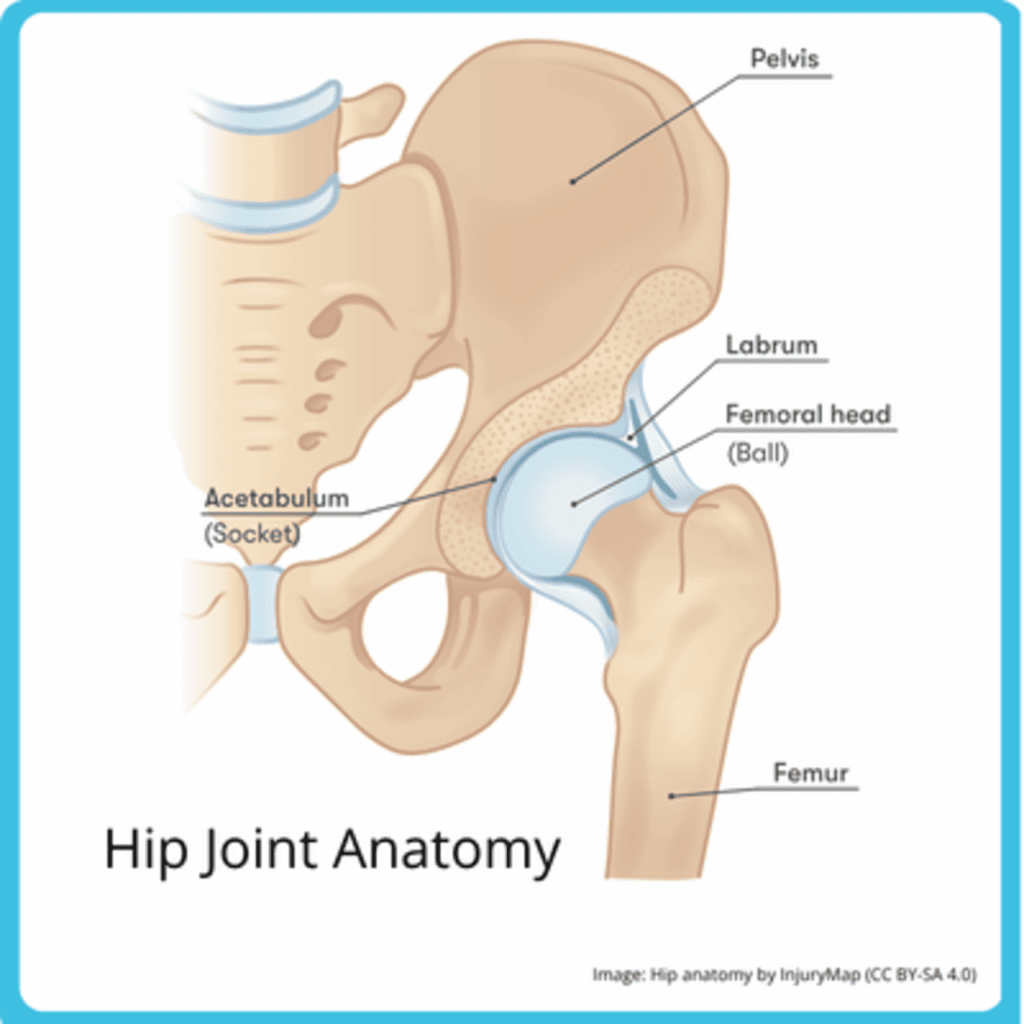
Femoroacetabular Impingement
Femoroacetabular impingement, often shortened to FAI, tends to occur in younger or more active adults, although not exclusively.
Pain is commonly felt in the groin and may be aggravated by positions involving deeper hip flexion, such as squatting, sitting for prolonged periods or certain sporting movements.
The shape of the hip joint can contribute to impingement, but again, imaging alone doesn’t make the diagnosis. Some people have these anatomical changes without experiencing hip pain.
We need to know whether the history, symptoms and physical examination fit together.
Hip Labral Problems
The labrum is a ring of cartilage around the edge of the hip socket.
Labral problems can produce groin pain and may sometimes be associated with clicking, catching or other mechanical symptoms.
But clicking doesn’t automatically mean you have a labral tear, and finding a labral change on an MRI doesn’t necessarily mean it is responsible for your pain.
This is another situation where we have to interpret the imaging in the context of the whole clinical picture.
Hip Flexor and Adductor-Related Pain
Not all groin pain comes from inside the hip joint.
The hip flexors and adductor muscles and tendons can also become painful, particularly following changes in training, repetitive loading or sporting activities involving running, kicking and changes of direction.
Here, muscle testing becomes particularly useful.
Does contracting the muscle reproduce your pain? What happens when we lengthen it? Is there a loss of strength? Is the pain associated with a particular activity or load?
Those findings help us determine whether the symptoms are more likely coming from muscle or tendon rather than from inside the joint.
Pain on the Outside of the Hip
Pain on the outside of the hip is extremely common.
Many people have been told they have “hip bursitis,” but we now understand that lateral hip pain is often more complicated than an inflamed bursa.
Greater Trochanteric Pain Syndrome
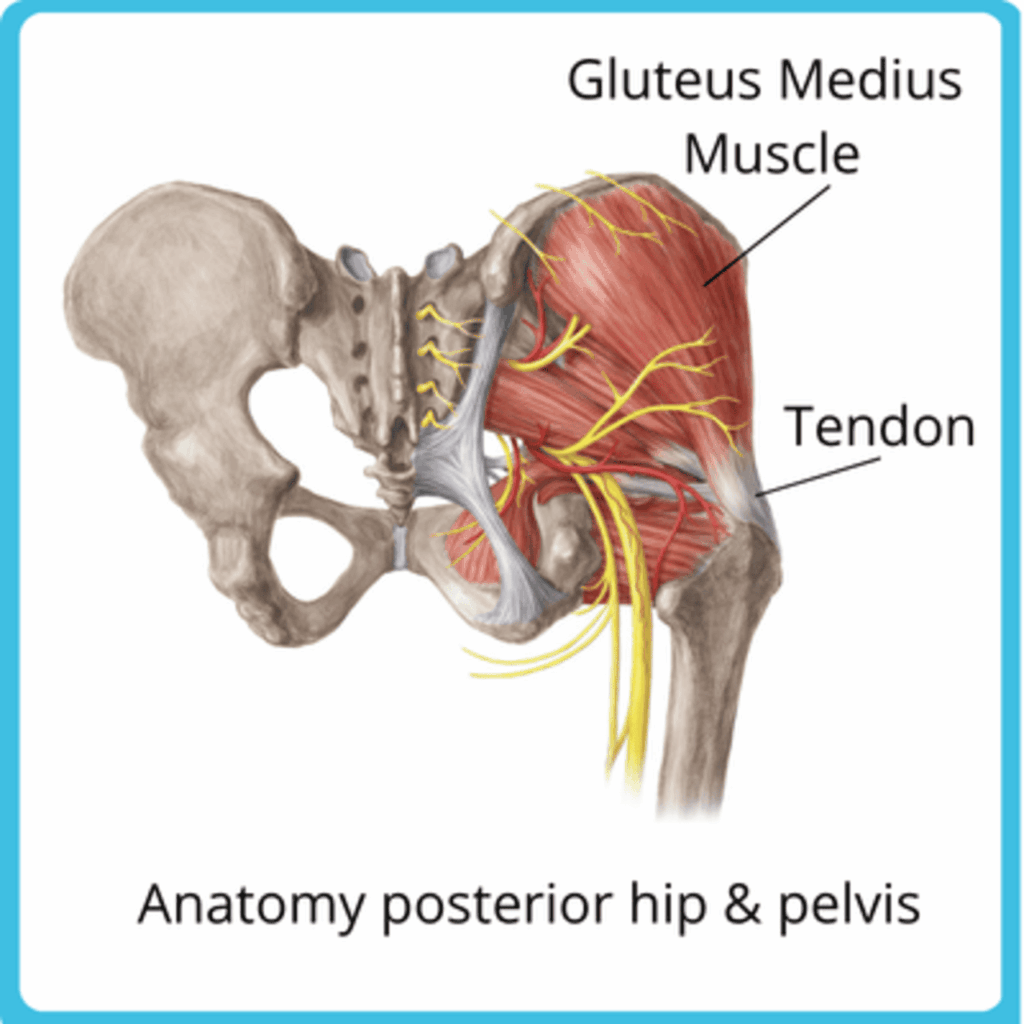
Greater trochanteric pain syndrome is the term commonly used to describe pain around the outside of the hip. It can involve the gluteal tendons and surrounding structures, including the bursa.
Gluteal tendinopathy is frequently an important part of the picture.
People often describe pain when lying on the affected side, walking longer distances, climbing stairs or standing on one leg. Some people also find crossing their legs or sitting in certain positions uncomfortable.
This is where the assessment needs to go beyond simply pressing on the sore area.
Tenderness tells us that an area is sensitive. It doesn’t necessarily tell us why.
We may assess gluteal strength, single-leg balance and control, walking, stairs and how the hip responds to different loading positions. We also want to understand whether there has been a recent change in activity or another reason the tissues may be struggling with their current demands.
That information starts to tell us what needs to change.
Pain in the Buttock or Back of the Hip
This is where determining the source of “hip pain” can become particularly interesting.
Pain in the buttock doesn’t necessarily originate from the hip.
Could It Be Coming From Your Back?
The lumbar spine can refer pain into the buttock, hip and leg.
Someone may arrive convinced they have a hip problem because that is where they feel the pain, yet their hip itself moves well and testing the hip doesn’t reproduce their symptoms.
Other clues may point us toward the back or nervous system. Symptoms may travel farther down the leg, include numbness or tingling, or change significantly with particular spinal movements or positions.
That is why a hip assessment sometimes includes examining your back.
We want to determine where the symptoms are coming from rather than simply treating where they happen to hurt.
Proximal Hamstring Tendinopathy
The hamstring tendons attach high in the buttock at the sitting bone.
Proximal hamstring tendinopathy can cause deep buttock pain, often aggravated by running, faster running, hills or prolonged sitting.
Testing hamstring strength and loading the tendon in different positions can help determine whether the hamstring is contributing to the symptoms.
Other Causes of Posterior Hip Pain
There are several other possible sources of pain around the back of the hip, including deep gluteal structures and the sacroiliac region.
This is also an area where relying on one painful spot or one special test can be misleading.
The pattern matters more than any single finding.
How Do We Actually Figure Out What Is Causing Your Hip Pain?
This is where physiotherapy assessment becomes important.
We don’t have one test that tells us, “This is definitely the source of your hip pain.”
Instead, we start building a clinical picture.
Where Is the Pain?
Groin? Outside of the hip? Buttock? Thigh? Does it travel farther down the leg?
The location begins to narrow down the possibilities.
What Brings It On?
Getting out of a car?
Walking?
Stairs?
Running?
Sitting?
Lying on your side?
Squatting?
Putting on your shoes?
The activities that reproduce your symptoms tell us a great deal about what structures are being loaded and what your hip is currently having difficulty doing.
How Did It Start?
A sudden injury while playing soccer gives us different information than pain that gradually appeared after increasing your running distance.
And both are different from hip pain that has slowly developed over several years.
The history matters.
How Does Your Hip Move?
We assess the amount and quality of movement available at the hip.
Is hip flexion limited? What about rotation? Is the movement painful? Is one side significantly different from the other?
Sometimes the amount of movement is more informative than where someone says it hurts.
What Happens When We Load Different Tissues?
We can test the muscles around the hip individually and in functional movements.
Can your gluteal muscles produce force comfortably?
What about your hip flexors, adductors and hamstrings?
Does loading one of these tissues reproduce the pain you came in with?
And importantly, how much can that tissue currently tolerate?
How Do You Move?
A table assessment only tells us part of the story.
Depending on your problem and your goals, we may want to see you walk, squat, climb stairs, balance on one leg, run, jump or perform part of the activity that is causing difficulty.
If your hip only hurts after five kilometres of running, knowing that you have normal hip range of motion on a treatment table isn’t enough.
We need to understand the demands you’re trying to return to.

Could It Be Coming From Somewhere Else?
Sometimes the most important part of assessing a hip is determining that the hip may not be the primary problem.
The lower back and nervous system can refer symptoms into the hip and leg. Groin pain can occasionally have causes outside the musculoskeletal system as well.
Part of a thorough assessment is recognizing when the presentation doesn’t fit a typical musculoskeletal pattern and when further medical assessment may be appropriate.
One Test Rarely Gives Us the Answer
This is an important point.
A painful hip impingement test doesn’t automatically mean you have hip impingement.
Tenderness over the outside of the hip doesn’t automatically mean you have bursitis.
Pain when contracting a muscle doesn’t automatically mean there is a tear.
And an X-ray showing osteoarthritis doesn’t automatically mean arthritis explains everything you’re experiencing.
Clinical tests are pieces of information.
We become much more confident when several findings begin telling the same story.
Your history, where you hurt, what aggravates your symptoms, your movement, strength, functional testing and, when appropriate, imaging should make sense together.
That is clinical reasoning.
Diagnostic Accuracy of clinical tests
Do You Need an X-Ray or MRI for Hip Pain?
Often, no.
Many common causes of hip pain can be assessed initially through a good history and physical examination.
Imaging may be appropriate when we are concerned about a fracture or stress fracture, significant joint pathology, avascular necrosis or another condition requiring further medical investigation. It may also become useful when symptoms aren’t improving as expected or when the diagnosis remains unclear.
And more imaging isn’t necessarily better imaging.
For many persistent hip problems where imaging is indicated, an X-ray may provide more useful initial information than immediately ordering an MRI.
The important question isn’t simply:
“Can we take a picture of it?”
It is:
“Will imaging give us information that changes what we do?”

The Diagnosis Helps Us Choose the Treatment
Figuring out what is contributing to your hip pain matters because different problems require different approaches.
Someone with a gluteal tendon problem may need to gradually rebuild the tendon and hip muscles’ ability to tolerate load.
Someone with hip osteoarthritis may benefit from education, improving strength and mobility, managing activity and gradually building physical capacity.
A runner with an adductor injury may need progressive strengthening followed by running and sport-specific loading.
Someone whose “hip pain” is actually being referred from their lower back needs an entirely different approach.
And even two people with the same diagnosis may not receive identical treatment.
One person may need more strength.
Another may need more mobility.
Someone else may have adequate strength and mobility but needs help gradually returning to running, hiking or another activity after months of avoiding it.
The diagnosis helps guide us.
The assessment tells us what that particular person needs.
When Should You See a Physiotherapist for Hip Pain?
You don’t need to wait until hip pain becomes severe before having it assessed.
If pain is persisting, interfering with sleep, limiting your walking or exercise, repeatedly returning, or stopping you from doing things that matter to you, an assessment can help clarify what may be contributing to it and what you can do about it.
There are also situations where physiotherapy shouldn’t be the only or first step. Significant trauma, inability to bear weight, unexplained severe or worsening pain, fever or feeling unwell, or other unusual symptoms may require medical assessment.
Knowing when something needs further investigation is part of good physiotherapy too.
The Avenue Perspective
Hip pain can be surprisingly complex.
The answer isn’t always sitting exactly where it hurts, and finding a tender muscle or an abnormality on an X-ray doesn’t necessarily give us the whole explanation.
A thorough assessment helps us put the pieces together: your story, your symptoms, your movement, your strength, the demands you place on your body and what you’re trying to get back to.
Once we understand what is most likely contributing to your pain, we can build a treatment plan around that.
Because the goal isn’t simply to treat a painful hip.
It’s to understand why your hip hurts and help you get back to using it with confidence.