Shoulder Pain When Lying Down: Why Does It Hurt and What Can You Do?
Shoulder Pain When Lying Down: Why Does It Hurt and What Can You Do?
Your shoulder may feel reasonably comfortable while you’re moving around during the day, but as soon as you lie down, it starts to ache.
Maybe you can’t lie on the painful shoulder. Maybe you roll onto the other side and it still hurts. Or perhaps even lying on your back isn’t comfortable.
It’s easy to assume that pain when lying down means something is damaged in your shoulder. But shoulder pain in bed doesn’t necessarily mean your shoulder is injured or getting worse.
Often, lying down simply places an already sensitive shoulder in one position for a long period of time.
The important question is not just “Why does lying down hurt?” but why has your shoulder become less tolerant of that position in the first place?
Why Does My Shoulder Hurt When I Lie Down?
During the day, your shoulder rarely stays in exactly the same position for very long.
You reach, walk, work, change positions and move your arm without even thinking about it. This continually changes the amount and location of load being placed through the shoulder.
When you go to bed, that changes.
Your shoulder may stay in a similar position for hours. Depending on how you sleep, some tissues may be compressed while others are held under low level tension.
A healthy, comfortable shoulder usually tolerates this without a problem.
But when a shoulder has become more sensitive, a position that normally wouldn’t bother you can suddenly become uncomfortable.
That’s why lying down may trigger your pain without actually being the cause of it.
Why Does It Hurt When I Lie on the Painful Shoulder?
This is probably the easiest one to understand.
When you lie directly on a painful shoulder, you add pressure to an area that is already sensitive.
The rotator cuff tendons, bursa, muscles and other structures around the shoulder all have to tolerate that sustained position.
That doesn’t mean you are damaging them by lying on your shoulder.
Think about a bruise. Pressing on it hurts because the area is sensitive, not because every time you touch it you are causing more damage.
A painful shoulder can behave similarly.
For now, changing your position may help you sleep. The long term goal, however, isn’t necessarily to avoid sleeping on that shoulder forever. It is to help the shoulder become strong and resilient enough to tolerate that position comfortably again.
Why Does My Shoulder Hurt When I Lie on the Opposite Side?
This one surprises people.
You stay off the painful shoulder, roll onto your “good” side and the sore shoulder still aches.
Why?
Look at what happens to your top arm when you lie on your side.
If it drops forward across your body or hangs unsupported, the weight of the arm can place a prolonged load through the shoulder. A position that feels perfectly fine for a few minutes may become uncomfortable after an hour.
Try placing a pillow in front of you and resting your painful arm on it, almost as though you are hugging the pillow.
Sometimes that small change is enough to make the position much more comfortable.
What If My Shoulder Hurts When I Lie on My Back?
Sleeping on your back takes away the direct pressure of lying on the shoulder, but the position of your arm can still matter.
If the shoulder is very sensitive, allowing the arm to fall backward or rest unsupported beside you may be uncomfortable.
Try placing a small pillow under your elbow and forearm so the arm is gently supported.
You don’t need to find the theoretically “perfect” shoulder position. You’re simply looking for a position that allows your shoulder to relax and lets you sleep.
Does Shoulder Pain When Lying Down Mean I Have a Rotator Cuff Tear?
No.
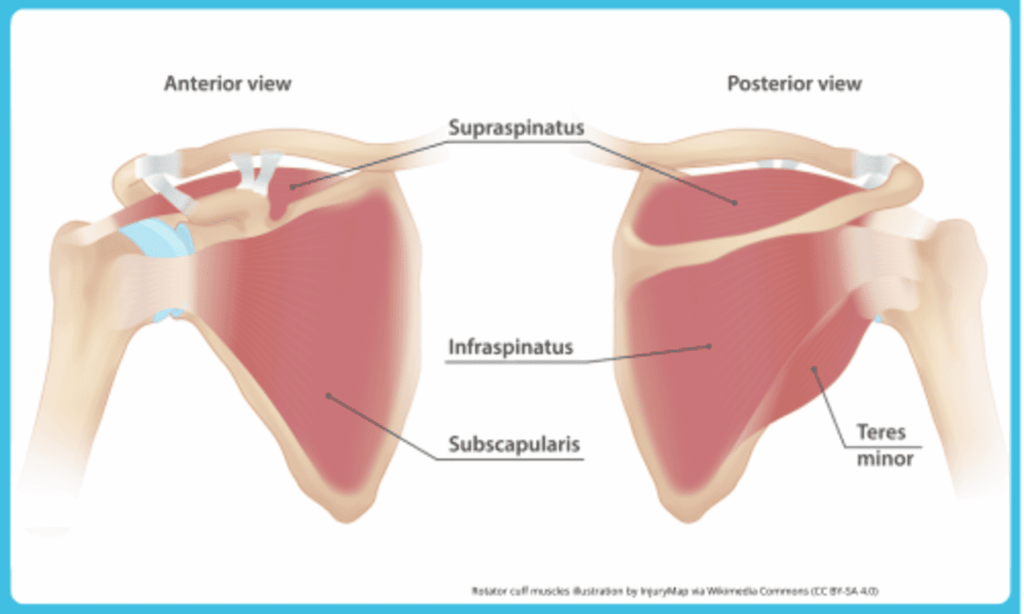
Rotator cuff problems can certainly cause pain at night and when lying down, but night pain alone cannot tell us whether you have a rotator cuff tear.
This is especially important as we get older because changes in the rotator cuff become increasingly common on imaging, including in people who have absolutely no shoulder pain.
Your physiotherapist will look at the whole picture, including:
how your symptoms started
where you feel the pain
your shoulder movement
your strength
which movements reproduce your symptoms
what activities you have difficulty doing
whether your neck may be contributing
A scan is sometimes helpful, but we don’t diagnose a shoulder based on an image alone.
We become more suspicious of the neck when symptoms travel farther down the arm or are accompanied by numbness, tingling, changes in sensation or symptoms that clearly change when you move your neck.
That doesn’t mean every aching shoulder needs an extensive neck work up.
It simply means that a good shoulder assessment shouldn’t assume the painful spot is automatically where the problem is coming from.
What About Frozen Shoulder?
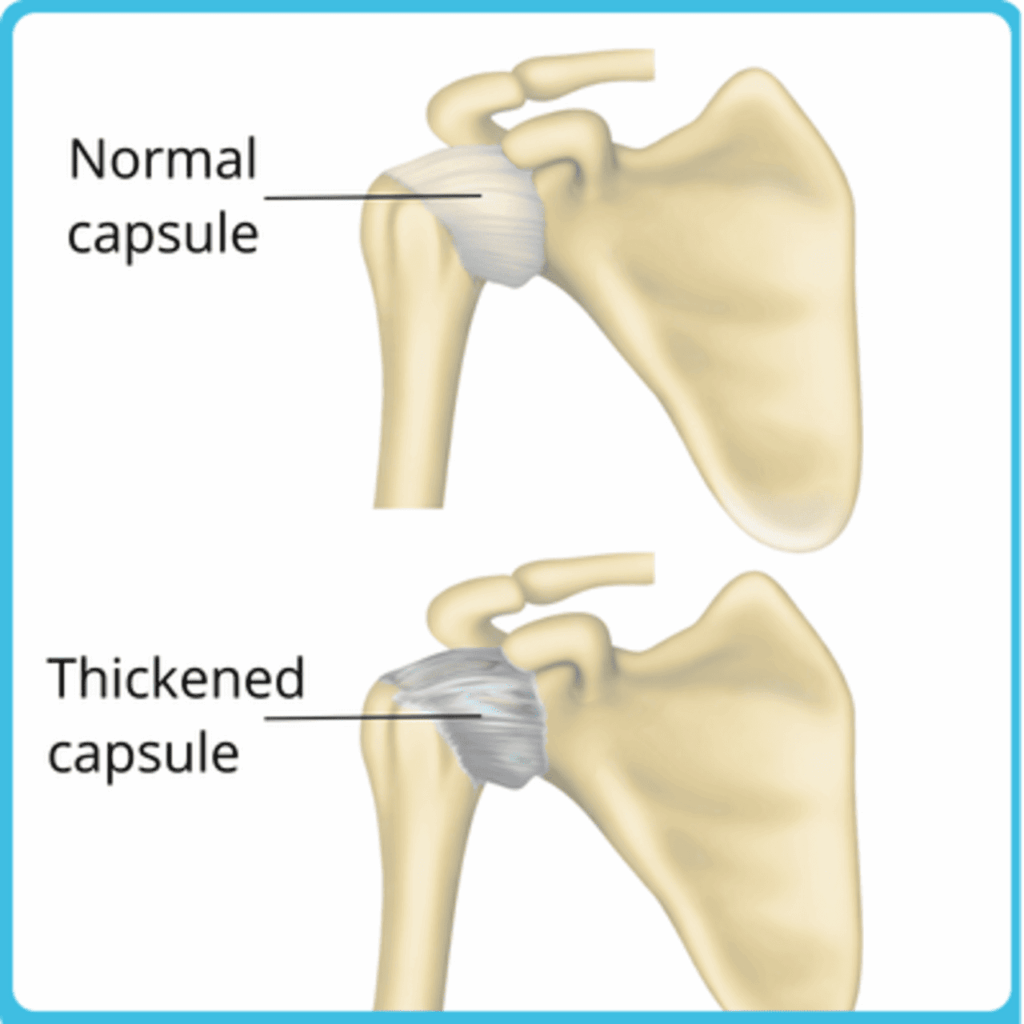
Frozen shoulder is another condition where night pain can be particularly troublesome.
One of the clues is that pain is accompanied by a progressive loss of shoulder movement.
You may notice it becoming increasingly difficult to reach behind your back, put on a coat, reach into a cupboard or lift your arm overhead.
Pain when lying down by itself doesn’t mean you have frozen shoulder. But if your shoulder is becoming progressively stiffer as well as painful, it is worth getting assessed.
Why Has My Shoulder Become So Sensitive?
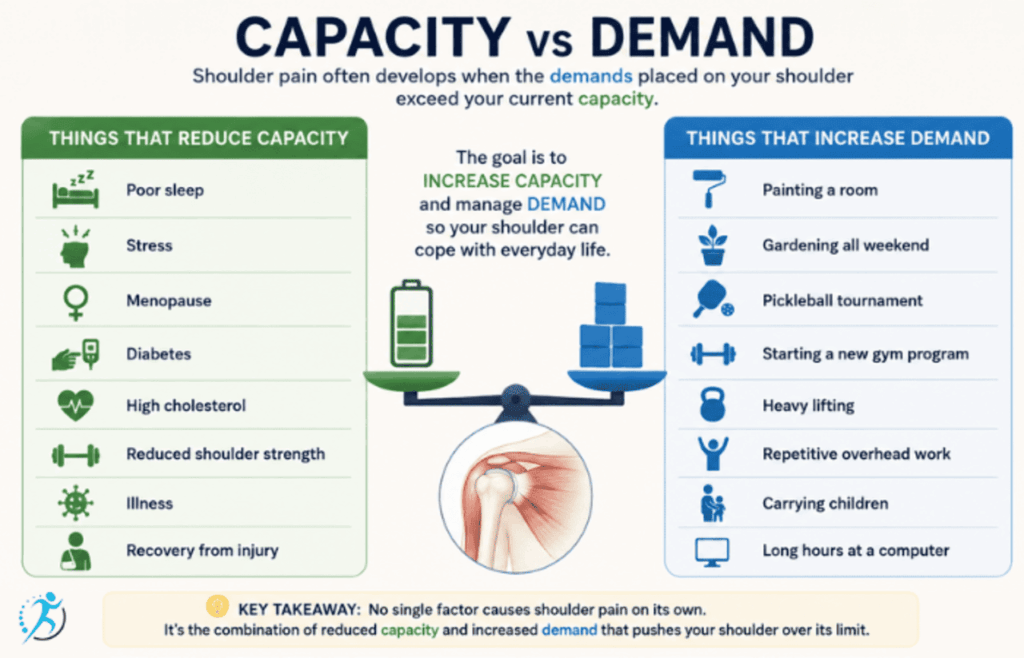
This is where we like to think about capacity versus demand.
Your shoulder has a certain capacity. This is the amount of load and activity it can comfortably tolerate.
The demands you place on it vary from day to day.
Maybe you increased your weights at the gym, started playing more pickleball or golf, spent a weekend gardening, painted a room, carried a child more than usual, worked unusually long hours at a computer or returned to an activity you hadn’t done for months.
Sometimes nothing obvious has changed.
Your shoulder’s capacity can also decrease during periods when you’ve been less active, haven’t been sleeping well, are recovering from illness, or simply haven’t been using the shoulder as much.
Pain often appears when the demands being placed on the shoulder exceed what it can currently tolerate.
At first, you may only notice discomfort after activity. As the shoulder becomes more sensitive, everyday things that never used to bother you, including lying in bed, can start to hurt.
This is why our goal with physiotherapy isn’t simply to find a comfortable pillow.
We want to build the capacity of the shoulder back up.
What Can I Do About Shoulder Pain When Lying Down?
Start with your sleeping position.
If you sleep on your back, try supporting the painful arm with a pillow under your elbow and forearm.
If you sleep on your non painful side, hug a pillow and allow the painful arm to rest comfortably on top of it.
If lying directly on the painful shoulder repeatedly wakes you, temporarily avoid that position while the shoulder settles.
But don’t completely stop using your shoulder during the day.
Gentle movement and appropriate activity are generally much more helpful than trying to protect the shoulder from all movement.
The bigger goal is to determine why your shoulder has become sensitive and gradually rebuild its tolerance to movement, strength and load.
For more strategies you can try tonight, read our guide: What to Do About Shoulder Pain at Night: A Step by Step Guide to Sleeping Better.
When Should I Get My Shoulder Assessed?
You don’t necessarily need physiotherapy the first night your shoulder bothers you in bed.
But consider getting it assessed if:
your sleep is regularly being disrupted
you are progressively losing shoulder movement
your shoulder feels weaker
reaching, lifting or getting dressed is becoming difficult
the pain keeps returning when you increase your activity
you have pain, numbness or tingling travelling farther down the arm
you simply aren’t sure what you should and shouldn’t be doing
If your shoulder pain started after significant trauma, you suddenly cannot lift your arm, or your symptoms are accompanied by other concerning symptoms such as chest pain, difficulty breathing, fever or unexplained swelling, seek appropriate medical assessment.
The Bottom Line
Shoulder pain when lying down doesn’t necessarily mean you are damaging your shoulder while you sleep.
More often, lying down places sustained pressure or tension on a shoulder that has already become sensitive.
Changing your sleeping position or supporting your arm with a pillow can help settle symptoms in the short term.
But if the problem keeps returning, the bigger question is why your shoulder is no longer tolerating a position that used to be comfortable.
That’s where strengthening, movement and gradually rebuilding your shoulder’s capacity become important.
Need Help With Shoulder Pain?
At Avenue Physio, we look beyond the painful spot.
Your physiotherapist will assess your shoulder movement and strength, consider whether your neck or upper back may be contributing, and look at the activities and loads that may have changed your shoulder’s tolerance.
From there, we build a treatment plan designed not only to settle your symptoms, but to help your shoulder become stronger and more resilient.
Lying down keeps your shoulder in a relatively fixed position for much longer than it normally stays during the day. If your shoulder has become sensitive, sustained pressure or tension can be enough to trigger pain even though the same shoulder feels reasonably comfortable while you’re moving.
Why does my shoulder hurt when I lie on the opposite side?
When you lie on your non painful side, your painful arm may fall forward or hang unsupported. This can place sustained load through the shoulder. Try supporting the arm on a pillow in front of you.
Should I avoid sleeping on my painful shoulder?
If lying on the shoulder increases your pain or repeatedly wakes you, changing position temporarily makes sense. This does not mean sleeping on the shoulder is damaging it. As your shoulder becomes less sensitive and better able to tolerate load, you may gradually become comfortable sleeping on that side again.
Does shoulder pain at night mean I have a rotator cuff tear?
No. Night pain can occur with many different shoulder presentations and cannot tell us on its own whether a rotator cuff tear is present. Your history, strength, movement and overall clinical presentation are more useful in determining what may be contributing to your symptoms.
Can physiotherapy help shoulder pain when lying down?
Yes. Physiotherapy can help identify why your shoulder has become sensitive, address movement or strength limitations, modify activities that may be aggravating it and gradually rebuild the shoulder’s capacity to tolerate everyday activities, including sleeping comfortably.



 Skip to content