Skip to content

Can Neck Pain Cause Jaw Pain? The Cervical Spine - TMJ Connection
The Short Answer
Your jaw does not function independently from your neck. When you open and close your mouth, the mandible moves relative to the skull while the head and cervical spine also make small, coordinated movements. Research has demonstrated coordinated mandibular and head-neck movement during jaw opening and closing, suggesting that jaw and neck movement function as an integrated system rather than as completely separate regions.
This does not mean that a stiff neck, a tight muscle or “poor posture” automatically causes jaw pain. Temporomandibular disorders (TMD) are multifactorial. However, cervical mobility, muscle endurance and movement can be relevant in some people with TMD, which is why a comprehensive TMJ Physiotherapy assessment may include both the jaw and the cervical spine. Research has found reduced cervical movement and neck extensor endurance in people with TMD compared with people without TMD.
To understand why the neck may matter, it helps to first understand the very specific biomechanical job of the upper cervical spine.
What Is the Biomechanical Job of the Upper Cervical Spine?
The upper cervical, or craniovertebral, region includes the base of the skull, the atlas or C1 vertebra and the axis or C2 vertebra. Its anatomy is quite different from the remainder of the cervical spine.
Its job is not simply to “hold up your head.” The upper cervical spine needs to provide enough mobility to orient the head while also providing the control necessary to keep the skull stable during movement. We continually make small adjustments through this region when we turn our head, look up or down, walk, change our gaze and move our jaw.
This combination of mobility and control is particularly important when we start thinking about jaw function. The temporomandibular joints are located on either side of the skull, and the mandible moves relative to that skull. The skull itself is not sitting on a completely rigid base. Its position is continuously being controlled by the cervical spine and surrounding muscles.
In other words, the jaw moves from a skull that is itself capable of moving.
C0–C1 and C1–C2 Have Different Jobs
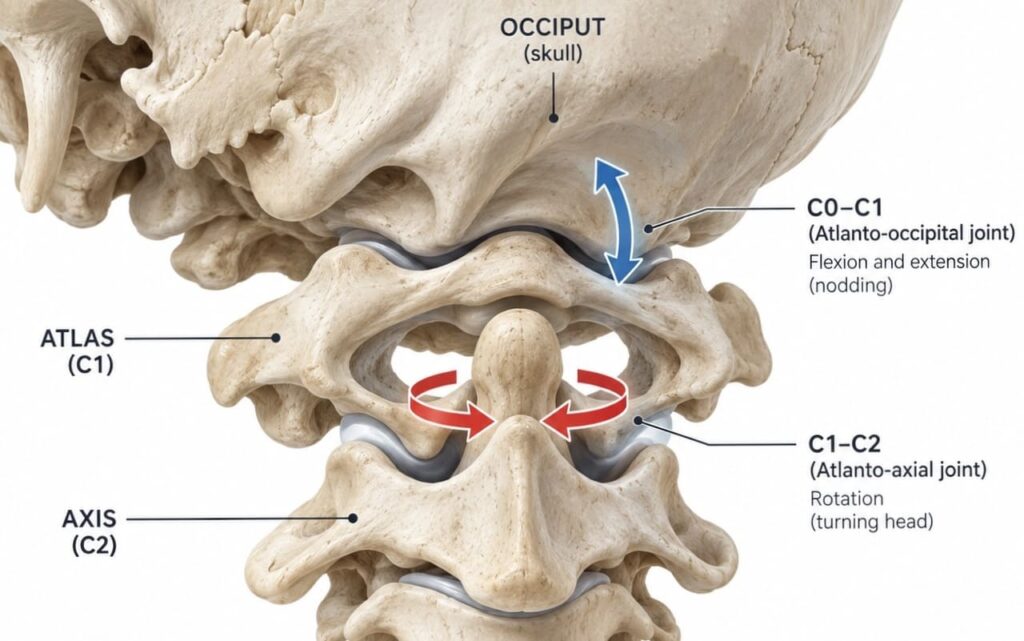
Although we often refer to C0–C2 collectively as the upper cervical spine, C0–C1 and C1–C2 are mechanically quite different.
The atlanto-occipital joints at C0–C1 sit between the base of the skull and C1. Their anatomy favours flexion and extension, including the small nodding movement that occurs when the skull moves relative to the upper neck. This region helps make subtle adjustments to the position of the head.
C1–C2 has a different design. The atlas rotates around the dens of C2, making this region particularly important for turning the head.
The upper and lower cervical spine then work together to create normal neck movement. When you look up, down or turn your head, the movement is distributed through the cervical spine rather than every vertebral segment contributing equally.
For a physiotherapist assessing someone with jaw pain, we therefore aren’t interested only in how far the neck can turn. We are interested in how the cervical spine is moving, whether particular regions are restricted or symptomatic, and whether those findings have any relationship to the person’s jaw movement or symptoms.
The Upper Cervical Muscles Do More Than Move Your Head
The muscles surrounding the upper cervical spine have an equally important role.
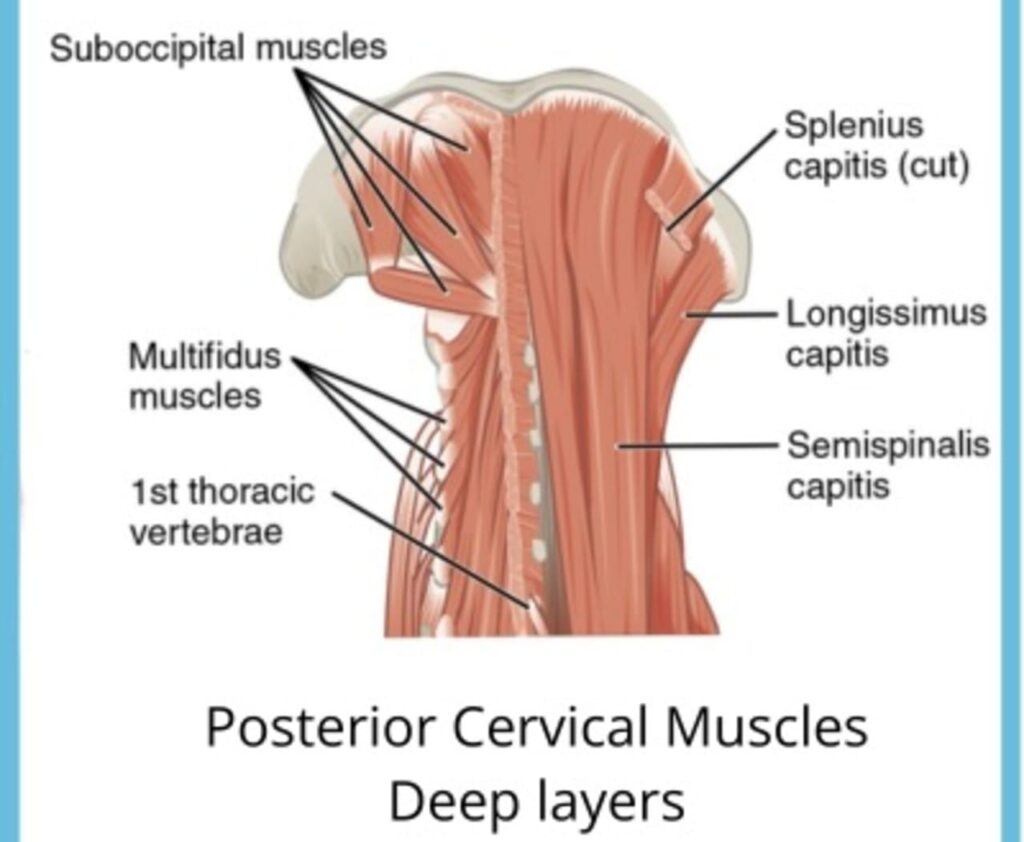
Immediately beneath the skull are the small suboccipital muscles, including the rectus capitis posterior major and minor and the obliquus capitis superior and inferior. Along with the deeper cervical muscles and larger muscles such as the sternocleidomastoid and cervical extensors, they contribute to controlling the position and movement of the head.
This is why simply describing a muscle as “tight” doesn’t tell us enough.
A muscle may be tender or have increased tone, but from a biomechanical perspective we are also interested in what that muscular system is being asked to do. Does the person have adequate cervical movement? Can they control the position of the head? Do the muscles have sufficient endurance? Is the person using a different movement strategy because another region isn’t moving comfortably?
This is particularly relevant to TMD because research has found that people with TMD demonstrate lower cervical extensor endurance and reduced upper and global cervical mobility compared with people without TMD. Importantly, the same systematic review found that craniocervical posture was similar between the two groups.
That gives us an important clinical distinction: the neck-jaw relationship appears to be more complicated than simply having “bad posture.”
Your Jaw Moves From a Moving Base
We often picture opening the mouth as the mandible simply dropping away from a stationary skull.
Biomechanically, that isn’t quite what happens.
Research measuring mandibular and head-neck movement simultaneously has demonstrated consistent, coordinated head and neck movement during jaw opening and closing. In healthy adults, jaw opening was accompanied by head-neck extension and jaw closing by head-neck flexion.
Further research examining the coordination of mandibular and head-neck movements supports the idea that jaw and neck movements are functionally integrated.
This means that some movement of the head and neck during jaw opening is normal. We should not automatically interpret it as compensation or dysfunction.
Instead, it reinforces the idea that the mandible and cervical region function as a coordinated mechanical system.
Jaw opening isn’t exclusively a movement of the TMJ. The jaw, skull and cervical spine participate in an integrated movement.
The Hyoid: A Mechanical Link Between the Jaw and Neck
There is another important structure in this relationship that is easy to overlook: the hyoid bone.
The hyoid sits in the front of the neck but does not directly articulate with another bone. Instead, it is suspended by muscles and soft tissues and forms part of the mechanical connection between the mandible, skull and anterior neck.
Above the hyoid are the suprahyoid muscles, including the digastric, mylohyoid, geniohyoid and stylohyoid. Several of these muscles contribute to opening the mouth when the hyoid is appropriately stabilized.
Below the hyoid are the infrahyoid muscles, which connect the hyoid and laryngeal region toward the sternum, clavicle and scapular region and help control the position of the hyoid.
This creates an interconnected muscular system extending from the mandible and skull through the hyoid into the anterior neck.
It would therefore be overly simplistic to think about the jaw muscles as just the masseter and temporalis. Jaw function involves a much larger muscular system, and some of those muscles have direct anatomical relationships with the neck.
What Happens Biomechanically When You Open Your Mouth?
Normal jaw opening is a surprisingly complex movement.
At the TMJ, opening involves both rotation and translation. Early in the movement, the mandibular condyle primarily rotates. As the mouth opens farther, the condyle-disc complex translates forward along the articular eminence.
Both sides also have to work together. The mandible is one bone connecting the right and left temporomandibular joints, which means we cannot completely separate what happens on one side from what happens on the other.
At the same time, muscles including the lateral pterygoid and suprahyoid group contribute to mandibular movement, the hyoid system is controlled, and coordinated movement occurs through the head and cervical spine. Studies of jaw function have demonstrated this coordinated relationship between mandibular and head-neck movement.
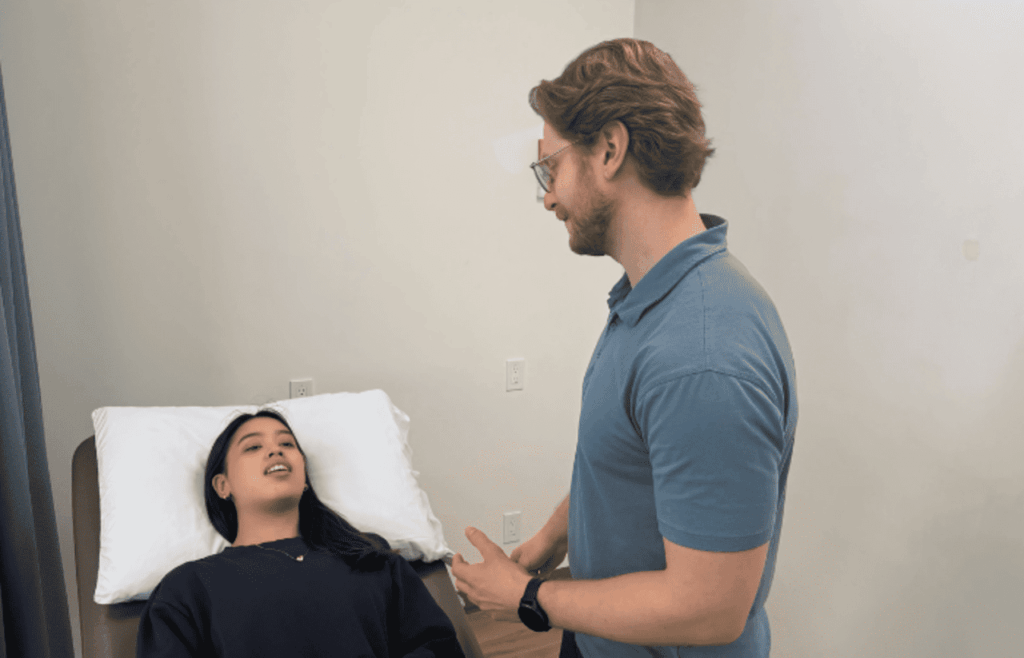
This is why during a TMJ Physiotherapy assessment we are interested in more than simply how many millimetres someone can open their mouth.
We want to see how the jaw gets there.
Does the mandible open in a relatively straight path? Does it deviate or deflect? Is one side translating differently from the other? Is there clicking or pain? How much head and neck movement accompanies opening? Does changing the position or movement of the cervical spine change what happens at the jaw?
Those findings can tell us considerably more than measuring mouth opening alone.
What About Forward Head Posture?
It is tempting to make the neck-jaw relationship very simple:
Forward head posture changes the position of the jaw, therefore forward head posture causes TMJ pain.
The research doesn’t support such a simple relationship.
Head and cervical position can change the mechanical environment in which the mandible operates, so position may be relevant for an individual patient. But systematic-review evidence found differences in cervical mobility and endurance in people with TMD without finding a significant difference in craniocervical posture.
Rather than trying to put everyone into one “perfect” posture, we are more interested in how well someone moves, how much capacity their muscular system has and whether particular positions actually influence their symptoms.
What Does the Research Show About the Neck and TMD?
The evidence supports a relationship between cervical and temporomandibular function, but it is important to distinguish an association from a cause.
A separate systematic review found an association between cervical and mandibular disability and moderate evidence for reduced cervical range of motion in people with TMD. However, evidence regarding cervical motor control and muscle activity was less consistent.
So the research doesn’t allow us to say that a particular stiff cervical joint or weak muscle is the cause of someone’s jaw pain.
What it does tell us is that jaw and cervical function are related and that cervical impairments are present in some people with TMD.
That is enough reason to assess the neck when the clinical presentation suggests it may be relevant.
How Do We Assess the Neck When You Have Jaw Pain?
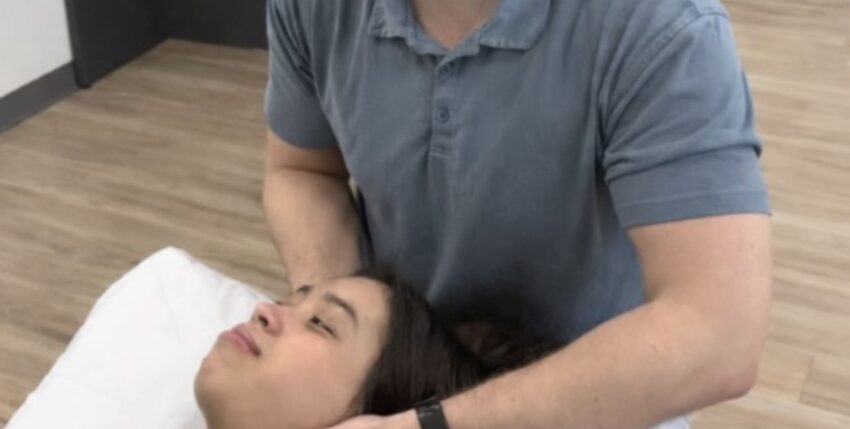
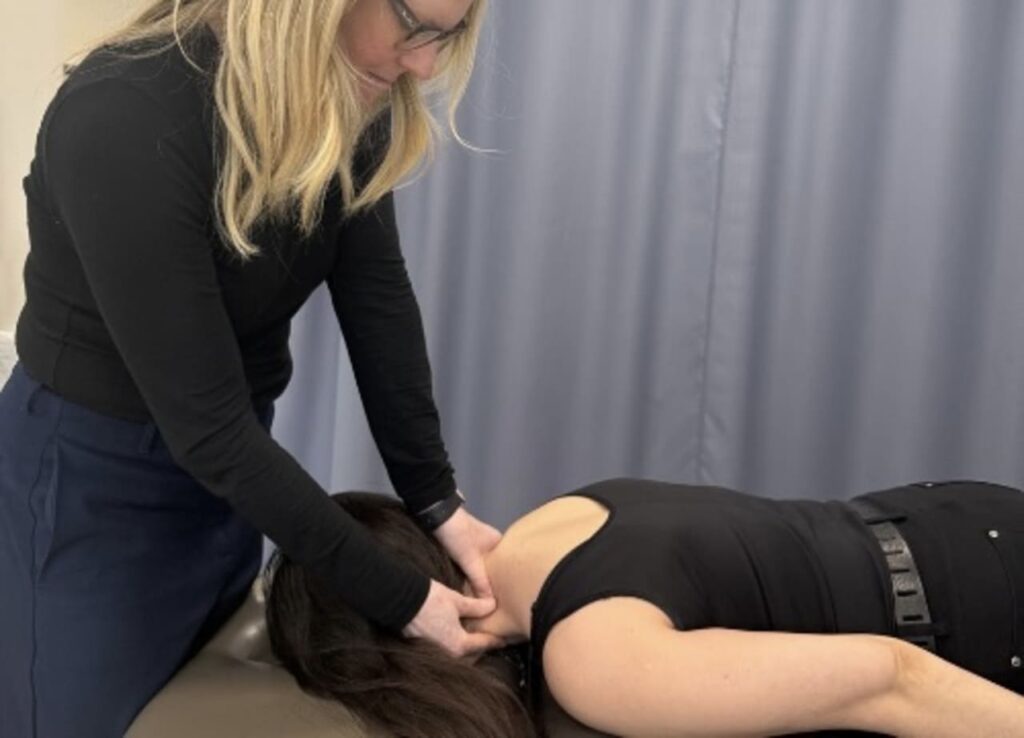
Because the jaw, skull and cervical spine function together biomechanically, we assess the neck as part of every TMJ physiotherapy assessment.
Along with assessing mouth opening, lateral excursion, protrusion, joint sounds and how the jaw moves, we look at cervical range of motion, upper cervical mobility, muscle strength and endurance, and the way the head and neck move during jaw function.
We pay particular attention to the upper cervical region because of its role in positioning and controlling the skull. We also look at how the upper and lower cervical spine work together, whether movement is restricted or painful, and whether there are differences in muscle control or endurance.
These findings are then considered alongside what we see at the jaw. For example, restricted upper cervical movement, reduced neck extensor and flexor endurance and changes in jaw movement may help us understand how the jaw and cervical spine are functioning together, rather than treating each area as a separate problem.
Our assessment then guides treatment. Depending on what we find, rehabilitation may focus primarily on the jaw or include treatment and exercise for both the jaw and cervical spine.
How Can Physiotherapy Help?
Treatment should follow the assessment.
For one person, the important findings may be primarily local to the jaw, and treatment may focus on mandibular movement, jaw exercises, education and the muscles surrounding the TMJ.
For another person, the assessment may also identify relevant cervical restrictions, reduced cervical muscle endurance or altered coordination between the head, neck and jaw. In that situation, treatment may include cervical mobility, strengthening or endurance exercises alongside treatment directed at the jaw.
A 2023 BMJ clinical practice guideline for chronic TMD pain strongly recommended several conservative approaches, including therapist-assisted mobilisation, supervised jaw exercise and stretching, supervised postural exercise, education and usual-care strategies such as home exercise.
The point isn’t that everyone with jaw pain needs their neck treated.
We treat the neck when the assessment suggests that the neck is relevant.
The Avenue Perspective
The jaw is difficult to understand if we look only at the temporomandibular joint.
The mandible moves relative to the skull. The skull is supported and moved by the cervical spine. The craniovertebral region provides considerable mobility while also controlling the position of the head, and the hyoid and surrounding muscles provide another mechanical connection between the jaw and anterior neck.
That doesn’t mean every person with TMD has a neck problem, and it doesn’t mean every cervical restriction needs to be corrected.
It means that when someone presents with jaw pain, we want to understand how the jaw, head and cervical spine are functioning together.
At Avenue Physio, our TMJ Physiotherapy assessment looks beyond simply finding where it hurts. We assess the movement and function of the jaw and, when relevant, the cervical spine to determine which findings are actually contributing to the problem.
Frequently Asked Questions
Can a neck problem cause jaw pain?
The neck can contribute to jaw symptoms in some people, but finding cervical stiffness or muscle tenderness doesn’t prove that it is causing the jaw pain. We look at the entire presentation and assess whether cervical movement, muscle function or treatment meaningfully changes the person’s jaw symptoms or movement.
Why does my neck move when I open my mouth?
Some head and neck movement during jaw opening is normal. Research has demonstrated coordinated mandibular and head-neck movement during opening and closing rather than completely independent movement of the two regions.
Can a stiff upper neck affect how my jaw moves?
Potentially, but it isn’t as simple as one stiff vertebra causing TMJ dysfunction. The upper cervical spine helps position and control the skull, which forms the base from which the mandible moves. If we find restricted cervical movement, the important question is whether that restriction is actually related to the person’s jaw movement or symptoms.
Should my neck be assessed if I have TMJ pain?
It can be particularly useful if you also have neck symptoms, headaches, restricted cervical movement or jaw symptoms that appear to change with head or neck movement. Research has identified cervical mobility and endurance differences in some people with TMD, although these findings do not mean that the neck is the cause in every patient.