Skip to content

Osteoarthritis: Why Your Joint Needs Movement, Not Protection
The Short Answer
If you have osteoarthritis, protecting a painful joint by using it less can seem completely logical. If the cartilage has changed or the joint space has narrowed, wouldn’t walking, squatting or strengthening simply wear it down faster?
That is not how a living joint works. Cartilage is living, mechanically responsive tissue, and the joint as a whole is capable of adapting to the demands placed on it. Exercise can improve strength, joint control, physical capacity and function, and current evidence does not support the idea that appropriately prescribed exercise simply wears away the cartilage in an osteoarthritic knee.
The goal isn’t to protect an osteoarthritic joint from movement. The goal is to understand how much load your joint can manage now and progressively build its capacity.
Your Joint Isn't a Car Part
Osteoarthritis has traditionally been described as “wear and tear.” It sounds simple, but it creates a misleading picture of what is happening inside the joint.
If the cartilage in your knee were like the tread on a tire, every step would use up a little more of it. Once you were told that some of the cartilage was gone, the logical response would be to conserve your steps, avoid loading the joint and save whatever cartilage you had left.
But cartilage isn’t rubber, and your knee isn’t a machine.
Articular cartilage is living tissue. It contains cells called chondrocytes within a highly organized extracellular matrix made largely of water, collagen and proteoglycans. It does not have the same direct blood supply as muscle, but it is metabolically active and responds to its mechanical environment.
This is an important part of the contemporary osteoarthritis story described by the Neuro Orthopaedic Institute, or NOI. Their patient-focused Knee Osteoarthritis Handbook explains that osteoarthritis is about much more than structural changes in the joint and explores how activity, knowledge and other biological processes can influence someone’s experience of knee OA.
Learn more in NOI’s Knee Osteoarthritis Handbook
Osteoarthritis certainly involves real structural changes within a joint, but those changes are occurring within a living biological system, not an inanimate mechanical part.
Think of Cartilage a Little Like a Sponge
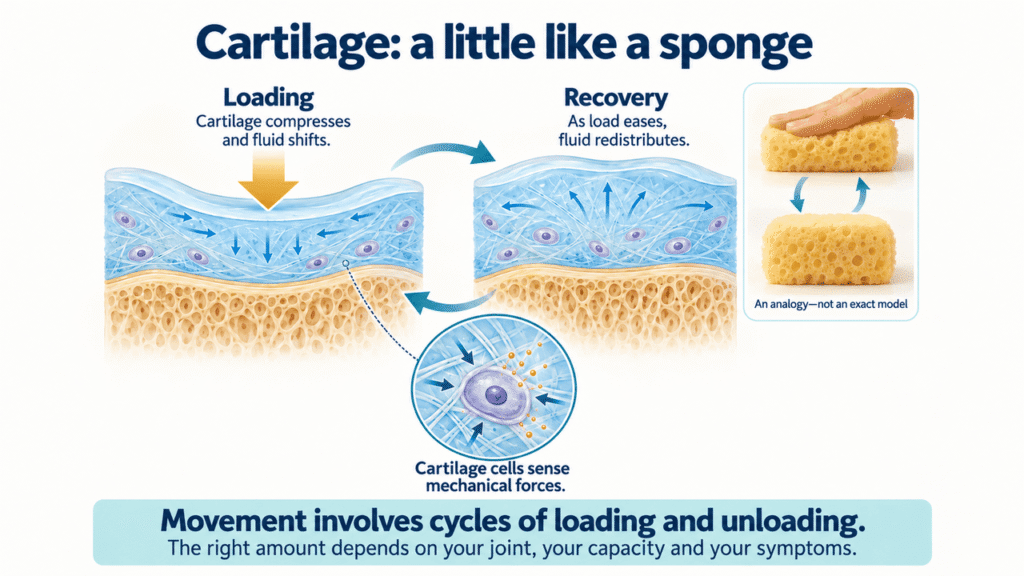
One simple way to understand what happens when cartilage is loaded is to think of it a little like a sponge.
A large proportion of articular cartilage is water. When you walk, climb stairs, squat or exercise, the cartilage is compressed and fluid moves within its matrix. When the load is reduced, the cartilage gradually recovers and fluid redistributes through the tissue.
Of course, cartilage is much more complex than a sponge. It contains living chondrocytes, collagen and proteoglycans, and these cells and tissues respond to the mechanical environment around them. But the analogy helps explain something important: cartilage is designed to experience cycles of loading and unloading.
Researchers can actually observe some of these changes with MRI. Studies measuring cartilage before and after activities such as walking, cycling and knee bends have demonstrated small, temporary changes in cartilage thickness, volume and composition after loading, followed by recovery.
That doesn’t mean that every type or amount of loading is beneficial. The dose matters. But it does challenge the idea that every step simply grinds away a little more cartilage.
Cartilage Responds to Its Mechanical Environment
Mechanical loading isn’t simply something cartilage has to survive. It is part of the biological environment in which cartilage lives.
Chondrocytes can respond to mechanical forces through a process called mechanotransduction. In simple terms, mechanical forces applied to the tissue can be converted into cellular signals. This is one of the ways living tissues respond and adapt to the demands placed on them.
The amount of load matters. Too little mechanical stimulus is not necessarily ideal for maintaining the capacity of the tissues and muscles around the joint, while suddenly exposing a joint to much more load than it is accustomed to can provoke symptoms.
This gives us a much more useful question than simply asking whether loading is good or bad: How much load is appropriate for this joint, for this person, right now?
Does Exercise Wear Away Cartilage?
This is one of the biggest concerns we hear from people with osteoarthritis, and fortunately it is something researchers have specifically investigated.
The best available evidence does not suggest that therapeutic exercise simply wears away knee cartilage. Research examining joint-loading exercise and cartilage structure has generally not found harmful effects on cartilage thickness, volume or structural defects. Some studies have also found potentially favourable changes in measures of cartilage composition, although the evidence is not strong enough to conclude that exercise regenerates cartilage.
Read the systematic review on exercise and knee cartilage
This matters because fear of damaging the joint can become a powerful reason to stop moving. If every painful step is interpreted as another piece of cartilage being worn away, avoiding walking makes sense. If squatting is thought to be grinding the joint down, strengthening the knee can seem dangerous.
International recommendations for exercise in hip and knee osteoarthritis take a very different position. Exercise is a core part of management, with the type, dose and progression adjusted to the individual.
Read the OARSI exercise recommendations for hip and knee osteoarthritis
Can Exercise Regrow Cartilage?
This is where the research becomes particularly interesting, but it is also where we need to be careful not to get ahead of the evidence.
We cannot currently tell someone with osteoarthritis that exercise will regrow the cartilage they have lost. What is changing is the question researchers are asking. Rather than looking only at whether exercise damages cartilage, scientists are increasingly investigating whether different types and doses of exercise can positively influence cartilage metabolism, composition and structure.
Some emerging studies have reported favourable changes in cartilage-related biomarkers and MRI measurements following exercise. These findings add to our understanding of cartilage as biologically responsive tissue, but a change in a biomarker or MRI measurement is not the same as demonstrating that exercise can reliably regenerate cartilage lost through osteoarthritis.
For now, the more accurate message is that we don’t yet know that exercise can regrow cartilage lost through OA, but the evidence does not support the old idea that appropriately prescribed exercise simply wears cartilage away.
Perhaps more importantly, your cartilage doesn’t have to regrow for you to get substantially better.
Cartilage Isn't the Whole Joint
People understandably become very focused on cartilage after being diagnosed with osteoarthritis. They want to know how much cartilage they have left, whether they are “bone on bone” and whether there is anything they can do to rebuild it.
Those are reasonable questions, but cartilage is only one part of the story. Osteoarthritis affects the whole joint, including cartilage, underlying bone, synovium, joint capsule and the muscles and other tissues surrounding the joint.
Then there is everything you need that joint to do. How strong are the muscles around the hip or knee? How well can you control the leg during movement? Can you comfortably get out of a chair, climb stairs or walk the distances you need to walk? How physically active are you, and what activities have you stopped doing because of your symptoms?
Those things can change even when an X-ray does not. You may return six months later with essentially the same X-ray but be stronger, walking farther, using stairs more comfortably and doing activities you had previously stopped.
That is meaningful change, even if the picture of the joint hasn’t changed.
Pain Is Normal With Osteoarthritis, but It Isn't a Damage Meter
This is an important part of understanding how to exercise with osteoarthritis.
Pain is common with OA, and experiencing pain during or after a joint-loading activity does not automatically mean you are damaging the cartilage or worsening the structural changes in the joint.
GLA:D® teaches this directly. Pain reactions during or after joint-loading activity can occur, and the response can vary from one person to another and even for the same person at different times.
That variability is important. You may walk the same distance on two different days and have a different response. Your joint has not necessarily undergone a structural change between Tuesday and Thursday. Symptoms can fluctuate depending on how much you have been doing, how the joint has recovered from previous activity, whether it is irritated or swollen and your overall physical capacity at that time.
So rather than treating any pain as a signal to stop, we use the pain response to help us understand how well the joint is tolerating the current amount of load.
How Much Pain Is Okay When You Exercise?
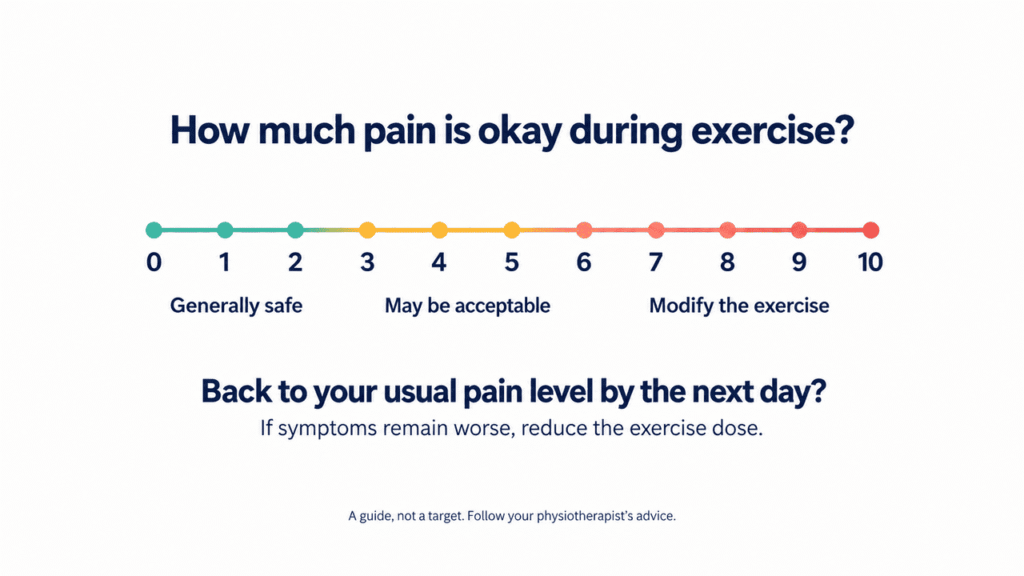
GLA:D uses a simple pain-monitoring model to help people understand this.
On a 0-to-10 pain scale, pain between 0 and 2 is considered safe, while pain up to approximately 5 out of 10 can be acceptable during exercise. Higher pain generally tells us that the exercise or activity should be modified.
But the number during the exercise is only part of the picture. The response afterward matters too.
If exercise increases your symptoms, GLA:D teaches that the pain should return to your usual or pre-exercise level within approximately 24 hours. A knee that becomes somewhat sore during exercise but returns to its usual level by the following day gives us very different information from a knee that is substantially more painful, swollen and difficult to use the next day.
This doesn’t give everyone permission to exercise at 5/10 pain, nor does it mean that 24 hours is a rigid rule for every situation. It gives us a framework for interpreting symptoms and adjusting the exercise dose.
Sometimes we reduce the resistance or repetitions. Sometimes we change the range of movement or allow more recovery between sessions. Sometimes nothing needs to change because the response is appropriate. As capacity improves, we may instead increase the challenge.
Pain becomes information we can use to guide exercise rather than an automatic signal that exercise is causing damage.
Finding Your Sweet Zone
This brings us back to the concept NOI calls the Sweet Zone.
Think of the amount of load you place on your joint as existing along a continuum. At one end is too little. Perhaps your knee becomes painful, so you stop taking the stairs, reduce your walking and eventually stop going to the gym. Over time, your quadriceps become weaker, your general fitness decreases and activities that were previously easy require more effort. Protecting the joint has unintentionally reduced its capacity.
At the other end is too much load too quickly. Imagine that you normally walk about 5,000 steps each day and then go on vacation and suddenly walk 15,000 steps for several days. Your knee becomes painful and swollen.
It would be easy to conclude that walking is bad for your arthritis. A more useful interpretation may be that 15,000 steps was simply more than your knee was currently prepared for.
Between those extremes is an amount of activity that provides enough challenge to stimulate adaptation while remaining manageable. That is the Sweet Zone.
Your Sweet Zone Isn't Fixed
Finding your Sweet Zone doesn’t mean determining the maximum amount of activity your arthritic joint is allowed to do for the rest of your life. We want your capacity to change.
Perhaps today you can walk comfortably for 15 minutes. With appropriate exercise and progressive loading, that may become 20 minutes, then 30 and eventually 45. Perhaps initially you need your arms to help you get out of a chair, but as your leg strength improves you no longer need them. Later you may be able to squat, climb stairs more easily or return to activities you haven’t done for months.
This is adaptation. The amount of exercise that is appropriate today should not necessarily be the amount you are doing three months from now.
The goal isn’t simply to stay within today’s limits. It is to progressively expand what your joint and your body can tolerate.
Why Does Exercise Help an Osteoarthritic Joint?
The cartilage story is fascinating, but it is only one reason exercise is such an important part of osteoarthritis management.
Exercise builds strength. For knee OA, the quadriceps are particularly important for activities such as walking, stairs, squatting and getting out of a chair. For hip OA, strength throughout the hip and lower limb contributes to the capacity required for walking, stairs and everyday activity. Rather than simply saying that stronger muscles “take pressure off” the joint, a better way to think about it is that stronger muscles increase the capacity of the whole system to manage load.
Exercise also improves how we control movement. Strength alone isn’t enough. Walking, stepping, balancing, changing direction and getting out of a chair require the nervous system and muscles to work together. This is one of the principles behind the neuromuscular exercise used in GLA:D®, which incorporates leg strength, core strength, functional movement and control of the joint during movement.
Learn more about GLA:D Canada’s exercise program
Most importantly, exercise builds physical capacity. Most people don’t come to physiotherapy because they want stronger quadriceps for the sake of having stronger quadriceps. They want to walk to work, travel, golf, ski, garden, get down on the floor with their grandchildren or use the stairs without planning their day around their knee.
Exercise gives us a way to progressively build the physical capacity required for those activities, while regular physical activity also benefits cardiovascular health, muscle mass, bone health, balance and general conditioning.
We aren’t simply treating a knee or hip. We’re increasing the capacity of the person who owns the joint.
What If I've Been Told My Knee Is “Bone on Bone”?
This phrase understandably worries people because it creates a powerful image of two exposed bones grinding against one another every time you take a step.
Significant joint-space narrowing on an X-ray is important information and may indicate advanced structural osteoarthritis. We don’t dismiss that. But the X-ray still cannot tell us exactly how much pain you should have, how strong you are, how far you can walk or how much you can improve.
Even with advanced osteoarthritis, muscles can become stronger, balance and movement control can improve, walking tolerance can increase and everyday activities can become easier. Exercise doesn’t require us to pretend the structural changes aren’t there. It means recognizing that many important parts of your function remain capable of change.
That is why our question isn’t simply, What does the X-ray look like?
It is also, What can this person still build?
Understanding Osteoarthritis Is Part of the Treatment
Imagine being given a strengthening program while believing that your knee is worn out, every painful repetition is damaging it and exercise will accelerate the arthritis. It would be completely understandable to be reluctant to exercise.
This is why education and exercise belong together.
Both NOI’s contemporary OA education and GLA:D emphasize helping people understand their condition alongside becoming more active. GLA:D combines education about osteoarthritis, pain, physical activity and self-management with supervised exercise.
Education isn’t a substitute for exercise. Understanding why movement is safe and worthwhile can make exercise possible again.
How GLA:D® Puts These Principles Into Practice
Understanding that exercise is important for osteoarthritis is one thing. Knowing where to start, what to exercise and when to make it harder is another.
GLA:D® Hip & Knee combines education with supervised neuromuscular exercise. Rather than simply strengthening one muscle, exercises address leg strength, core stability, functional movement and control of the joint during movement, with exercises progressed according to the individual’s ability.
The program also reinforces the importance of exercise dose and consistency. GLA:D is not about doing the hardest exercise possible. It is about providing an appropriate challenge, allowing the body to respond and recover, and progressively increasing what someone can do.
That is the same principle we’ve been discussing throughout this article: start with what the joint can manage now, challenge it appropriately and progressively build its capacity.
How Do We Find Your Starting Point?
There isn’t one osteoarthritis exercise program that is right for everybody.
Someone who cycles three times a week but struggles with stairs needs something very different from someone who has gradually stopped exercising because walking around the block has become painful.
We assess joint movement, strength, balance, functional activities and current activity tolerance, but we also need to understand what you want to get back to. Walking comfortably downtown is different from returning to skiing. Gardening requires something different from running, while travelling comfortably may require different capacities again.
Your starting point is based on what you can do now. Your destination is based on what you want to be able to do.
Rehabilitation is about progressively building the capacity between the two.
The Avenue Perspective
An osteoarthritic joint does not need to be protected from movement simply because osteoarthritis is present. It needs the right amount of movement and load.
Too little activity can contribute to loss of strength and physical capacity. Too much load too quickly can aggravate symptoms. In between is an opportunity to challenge the joint, allow the body to adapt and progressively build what you can do.
That amount won’t be identical for everybody, and it won’t stay the same forever. This is why we don’t simply hand someone with osteoarthritis a generic sheet of exercises. We want to understand the joint, your current physical capacity, how you respond to load and what you want to return to. From there, we can determine an appropriate starting point and progressively move it forward.
For some people that means individual physiotherapy. For others, a structured program such as GLA:D® Hip & Knee provides the education, progressive exercise and support they need.
The goal isn’t simply to protect your joint. It’s to help you build the strength, capacity and confidence to keep using it.
Frequently Asked Questions
Can exercise make osteoarthritis worse?
A well-designed exercise program is not expected to worsen hip or knee osteoarthritis. Exercise is recommended as a core component of OA management, but the type, starting dose and progression should reflect the individual. Temporary increases in symptoms can occur and may mean the exercise needs to be adjusted rather than stopped altogether.
Is it okay for my knee to hurt when I exercise?
Yes, some pain can be acceptable. GLA:D uses a pain-monitoring approach in which 0–2/10 pain is considered safe and pain up to approximately 5/10 can be acceptable during exercise, provided symptoms return to their usual level within approximately 24 hours. The amount of pain, swelling and recovery afterward all help us determine whether the exercise dose is appropriate.
Can exercise regrow cartilage?
We don’t currently have enough evidence to say that exercise reliably regrows cartilage lost through osteoarthritis. Research into how exercise influences cartilage metabolism and structure is evolving, but we can say with greater confidence that appropriately prescribed therapeutic exercise does not appear to simply wear knee cartilage away.
What is the best exercise for hip or knee osteoarthritis?
There isn’t one best exercise for everyone. Strengthening, aerobic exercise, neuromuscular training, flexibility and balance can all have a role. The exercise needs to match your current abilities, symptoms and goals, provide enough challenge to create adaptation and then progress as your capacity improves.