Skip to content

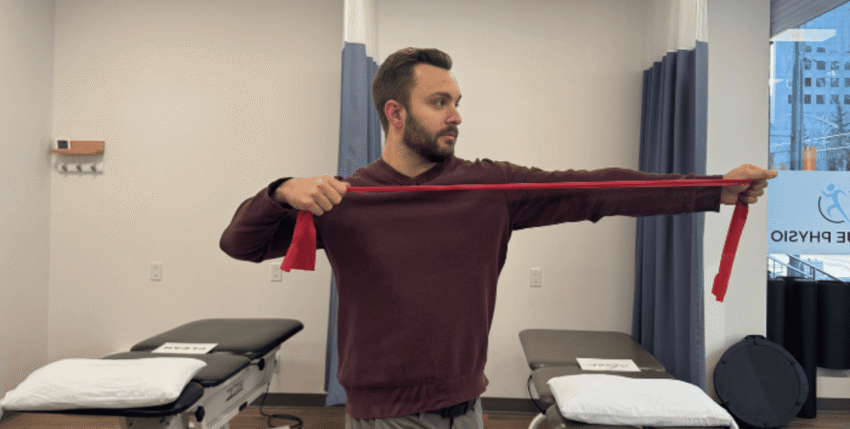
How to Relieve Rotator Cuff Pain at Night: Why Shoulder Strength and Movement Matter
The Short Answer
If your rotator cuff hurts at night, changing your sleeping position may help you feel more comfortable, but it doesn’t necessarily address why your shoulder is painful in the first place.
For many people with rotator cuff-related shoulder pain, the more effective long-term approach involves improving how the shoulder moves and gradually increasing its ability to tolerate load. That means strengthening the rotator cuff, improving coordination between the arm and shoulder blade, and choosing exercises that challenge the shoulder without repeatedly aggravating symptoms.
The rotator cuff has a demanding job, and it doesn’t work alone. Understanding how the muscles around your shoulder work together can help explain why exercise is such an important part of recovery.
Why Does Rotator Cuff Pain Feel Worse at Night?
Shoulder pain can be particularly frustrating at night. You might manage reasonably well during the day, only to find that lying down makes your shoulder ache or that rolling onto one side wakes you from sleep. It’s understandable to wonder whether something is getting worse, particularly when the pain seems more intense while you’re doing very little.
Night pain is common with rotator cuff-related shoulder conditions, but it doesn’t automatically mean that a tendon is tearing further or that damage is progressing. Sustained pressure on an already sensitive shoulder can be uncomfortable, while poor sleep and increased pain sensitivity may also contribute. The shoulder’s response to daily activities can influence symptoms, although nighttime pain cannot be explained by loading alone.
Supporting your arm with a pillow or temporarily avoiding a painful sleeping position may help you rest. We’ve discussed these strategies in more detail in our articles What to Do About Shoulder Pain at Night and Why Does My Shoulder Hurt After Sleeping?.
However, changing how you sleep doesn’t improve shoulder strength or its capacity to tolerate everyday activities. For longer-term improvement, we need to understand how the shoulder works and how specific exercises can help.
Why Is It So Tough to Be a Rotator Cuff?
The rotator cuff consists of four muscles: supraspinatus, infraspinatus, teres minor and subscapularis. Together, they contribute to movement and stability at the shoulder joint, helping control the head of the humerus within the shallow socket of the shoulder blade.
Unlike the hip, which has a relatively deep socket, the shoulder is designed for an extraordinary amount of movement. That mobility makes it possible to reach overhead, throw a ball, lift groceries, get dressed and perform countless everyday tasks. But this freedom of movement comes with a challenge: the shoulder relies heavily on muscular control to manage the forces acting on the joint.
The rotator cuff helps compress and control the humeral head within the glenoid, or shoulder socket. It also produces and resists rotation and works alongside larger muscles such as the deltoid during arm elevation. These muscles must continually adjust their activity depending on the position of the arm and the demands of the task.
Think about lifting a heavy plate onto a high shelf. As your arm rises, the direction and magnitude of the forces acting on the shoulder change. The deltoid contributes to lifting the arm, the rotator cuff helps control the humeral head, and the muscles around the scapula help position the socket. This coordination happens continuously, usually without any conscious effort.
The rotator cuff must be strong enough to produce force, responsive enough to control movement and capable of tolerating repeated loading throughout the day. It’s a demanding job for four relatively small muscles, particularly when we consider how frequently we use our arms and how much the demands change as we reach, lift and carry.
Fortunately, the rotator cuff doesn’t work in isolation. Its function depends on coordinated movement with the deltoid and the muscles that control the shoulder blade.
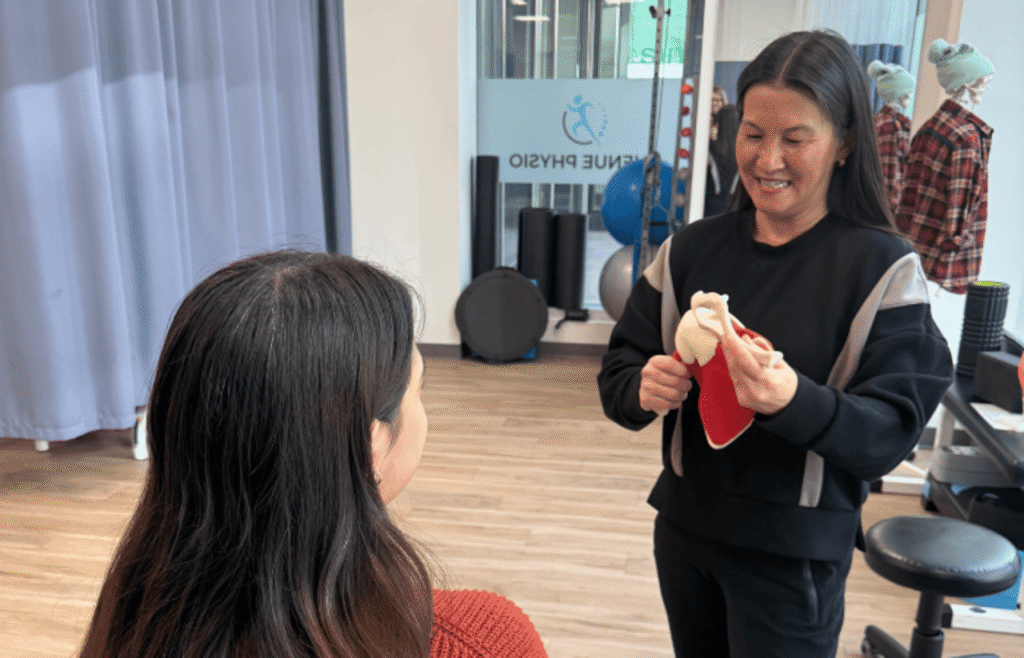
The Shoulder Blade: Why Upward Rotation Matters
One of the most interesting aspects of shoulder mechanics is that the socket isn’t fixed in place. It is part of the scapula, or shoulder blade, which moves along the rib cage as you raise and lower your arm.
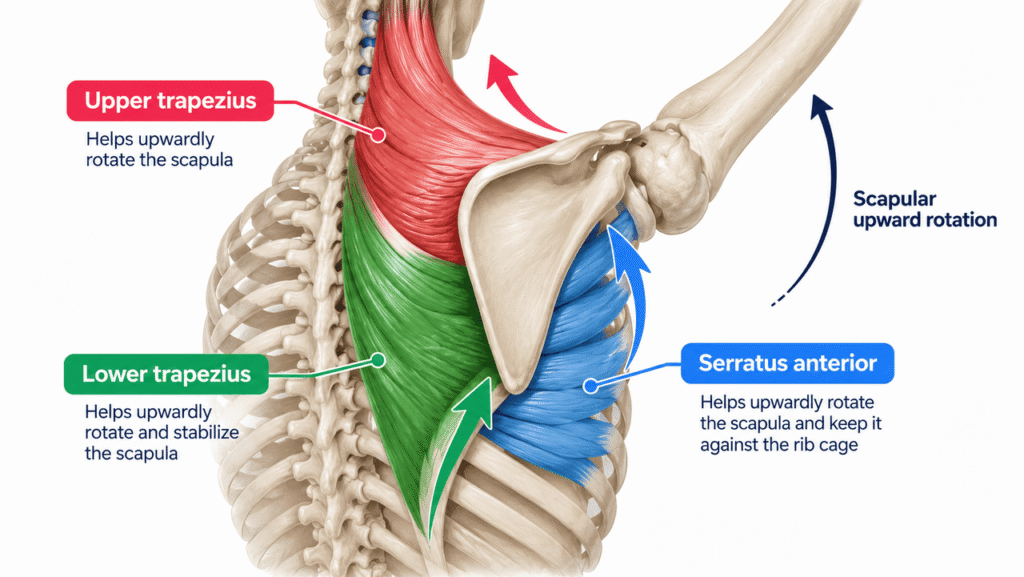
When you lift your arm overhead, the scapula normally rotates upward, tilts backward and rotates externally. These movements help orient the glenoid as the humerus elevates, allowing the ball and socket to move together rather than treating the shoulder as a ball moving inside a stationary socket. This coordinated movement is commonly described as scapulohumeral rhythm.
Two muscles are particularly important in this process: the serratus anterior and trapezius. Working together, they contribute to the upward rotation of the scapula as the arm rises. The serratus anterior also helps control the scapula against the rib cage, while different portions of the trapezius contribute to positioning and rotating the shoulder blade.
Think of the scapula as a moving platform from which the rotator cuff works. As the arm elevates, the platform changes position, helping orient the socket for the movement. Upward rotation, posterior tilt and external rotation influence the relationship between the humerus, scapula and surrounding tissues, and may help distribute forces as the rotator cuff and deltoid work together.
You may hear this described as unloading the rotator cuff, but that explanation is incomplete. The rotator cuff still needs to work during overhead movement, and we don’t want to eliminate its workload. We want the entire shoulder complex to coordinate movement and develop the capacity to tolerate the forces involved.
This is also why constantly pulling your shoulder blades down and back isn’t necessarily helpful. When you reach overhead, your scapula needs to rotate upward. Holding it down may interfere with that natural contribution to movement. The goal isn’t to hold the shoulder blade in one supposedly perfect position; it’s to develop strength, control and freedom of movement.
Can Changing Shoulder Blade Movement Reduce Pain?
Sometimes, and this is one of the useful aspects of assessing shoulder pain.
Shoulder physiotherapist Jo Gibson has emphasized the value of symptom modification: changing an aspect of a movement and observing whether pain or function improves. For example, someone may experience pain when raising their arm overhead. During assessment, a physiotherapist can assist the scapula into upward rotation while the person repeats the movement.
If the movement becomes more comfortable, that gives us useful information. It suggests that changing the coordination of the shoulder complex may provide a helpful rehabilitation strategy. It doesn’t prove that the shoulder blade was moving incorrectly or that a tendon was being compressed, but it identifies a movement modification that may help the person exercise more comfortably.
We can then select exercises that encourage the patient to reproduce that improvement independently. One useful example is the wall slide, which we’ll discuss below.
Four Exercises to Improve Rotator Cuff Strength and Shoulder Control
There isn’t one exercise that works for everyone with rotator cuff pain. The starting point depends on symptom irritability, strength, range of motion and the activities the person wants to return to.
The 2025 clinical practice guideline for rotator cuff tendinopathy recommends active rehabilitation, including resistance and motor-control exercises, as an initial treatment approach. The following exercises illustrate how we might progress from comfortable loading to more demanding shoulder control and strengthening. They are examples of a progression, not four exercises that everyone needs to perform.
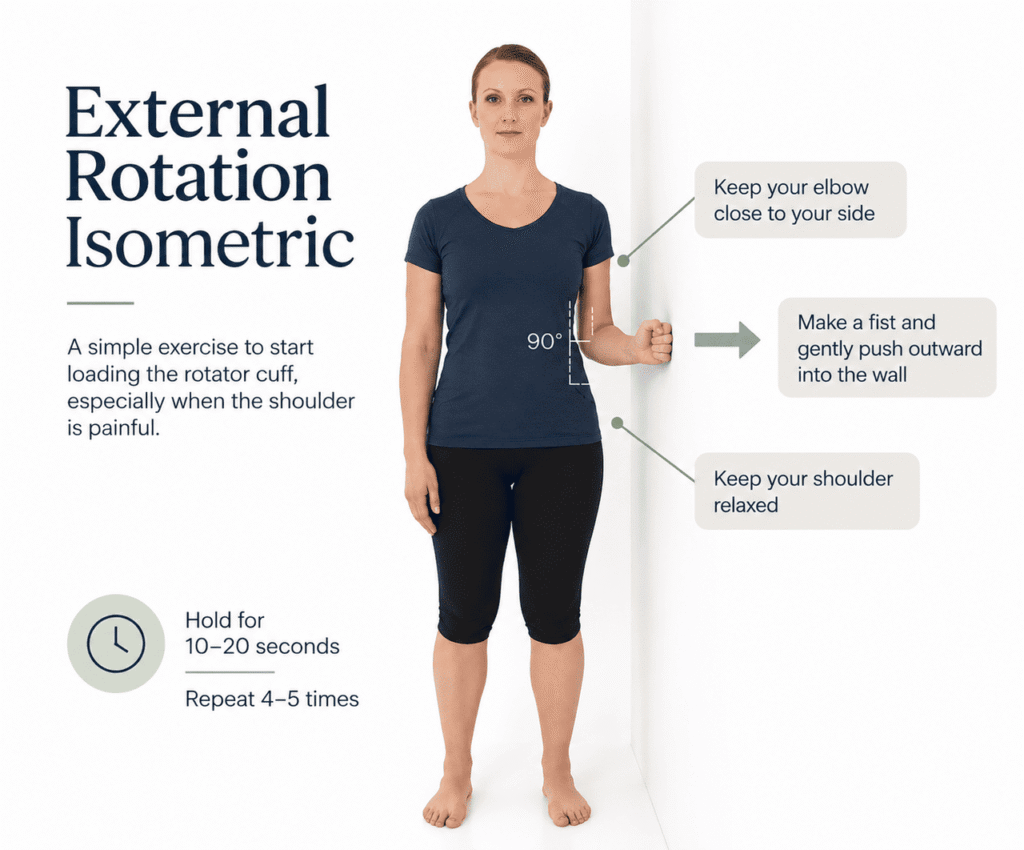
1. Rotator Cuff Isometrics: A Starting Point for an Irritable Shoulder
When the shoulder is particularly painful, resisted movement through a range may be uncomfortable. Isometric exercises can offer a manageable starting point because they allow a muscle to produce force without significant movement at the joint.
For an external rotation isometric, stand beside a wall with your elbow bent to approximately 90 degrees and resting comfortably near your side. Place the back of your hand against the wall and gently push outward without allowing your arm to move. This activates the external rotators of the shoulder, particularly infraspinatus and teres minor.
Start with a comfortable amount of effort rather than pushing as hard as possible. A possible starting point is four or five holds of 10–20 seconds, with rest between repetitions. The effort and duration can be adjusted according to how the shoulder responds.
Isometrics aren’t necessarily better than exercises involving movement, and they don’t reliably provide immediate pain relief for everyone. Their advantage is that they allow us to introduce load in a controlled way. For some patients, this is where rehabilitation begins; others can move directly into strengthening exercises.
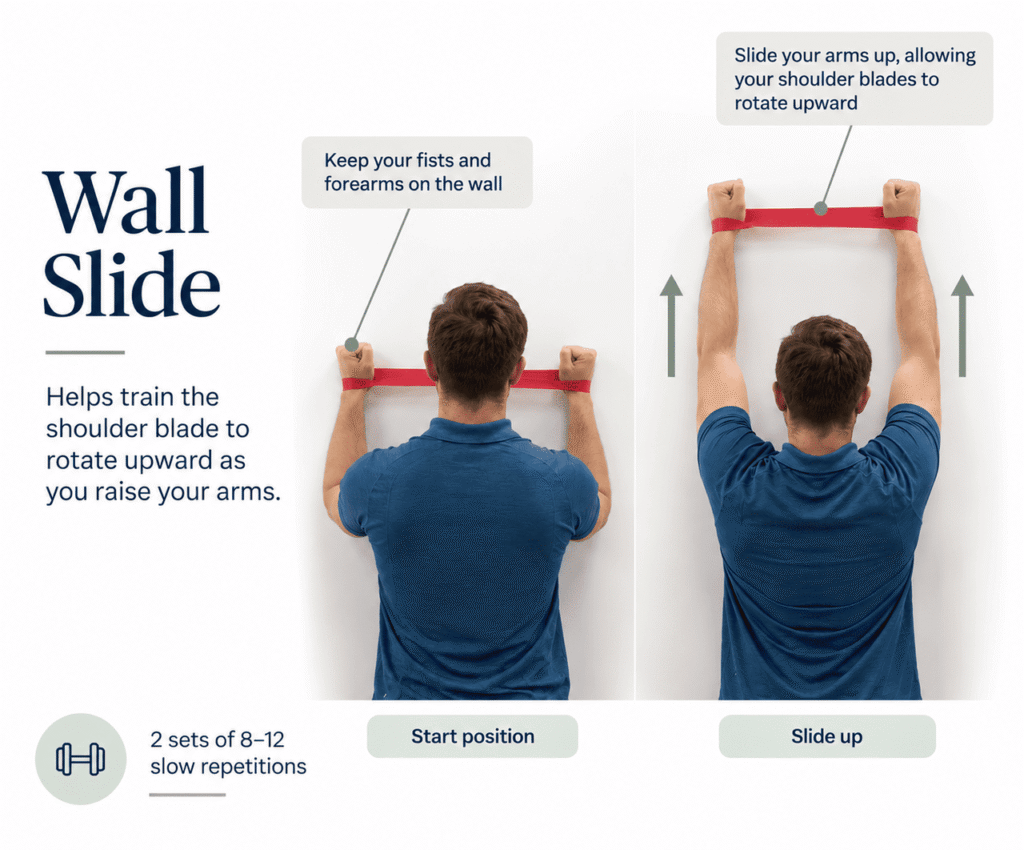
2. Wall Slides: Encouraging Scapular Upward Rotation
Wall slides are particularly useful when we want to explore how the scapula contributes to arm elevation, especially when supported movement is more comfortable than lifting the arm freely.
Stand facing a wall with your forearms resting against it and your elbows bent. Gently slide your forearms upward, allowing your shoulder blades to rotate naturally as your arms rise. Rather than pulling your shoulder blades down and back, allow them to move around the rib cage.
As the arms elevate, serratus anterior and trapezius contribute to upward rotation of the scapula. For some people, using a foam roller between the forearms and wall provides a comfortable way to guide the movement. A light resistance band around the forearms can add a further challenge, provided it doesn’t increase symptoms.
Begin with a comfortable range, perhaps two sets of 8–12 slow repetitions. The important question isn’t whether the exercise produces a perfect-looking scapular movement. It’s whether it helps the person move more comfortably and develop better control and tolerance.
3. Progressive Rotator Cuff Strengthening: Building Capacity
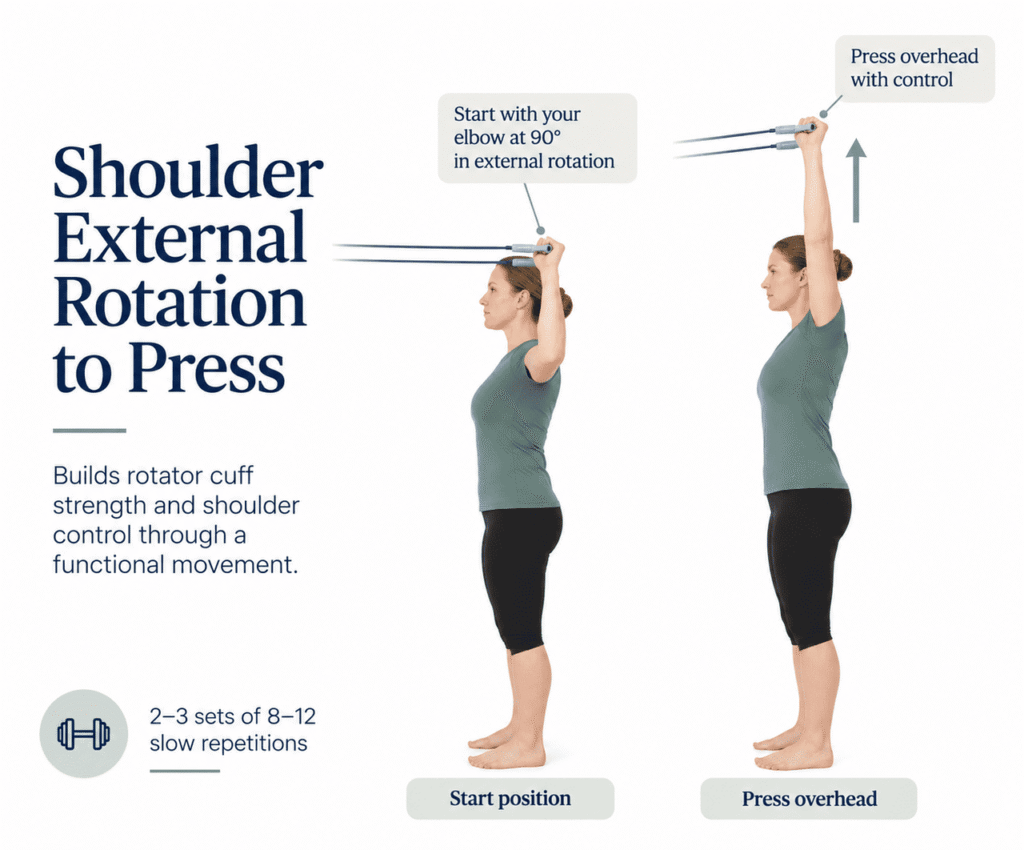
Isometrics and supported movements can be useful starting points, but rehabilitation needs to progress. The rotator cuff must eventually tolerate greater resistance and work through different arm positions, because its demands change considerably as the arm moves away from the body.
External rotation using a resistance band or dumbbell is a common example. With your elbow near your side, slowly rotate your forearm outward against resistance, then return with control. The exercise challenges the external rotators as they shorten and lengthen through the movement.
As strength improves, we can increase resistance and introduce exercises with the arm farther away from the body. Someone returning to swimming, tennis, golf, weight training or repetitive overhead work needs more than strength with the elbow tucked against the ribs. Later rehabilitation may include resisted shoulder elevation, external rotation at greater degrees of abduction, loaded carrying and overhead pressing.
A possible starting point for strengthening is two or three sets of 8–12 repetitions using resistance that feels challenging but manageable. The appropriate load and frequency will vary, and the goal isn’t simply to complete a prescribed number of repetitions. It’s to develop a shoulder that can tolerate the demands of everyday life.
4. High-Plank Stability Ball Rollbacks: Challenging Scapular Control Under Load
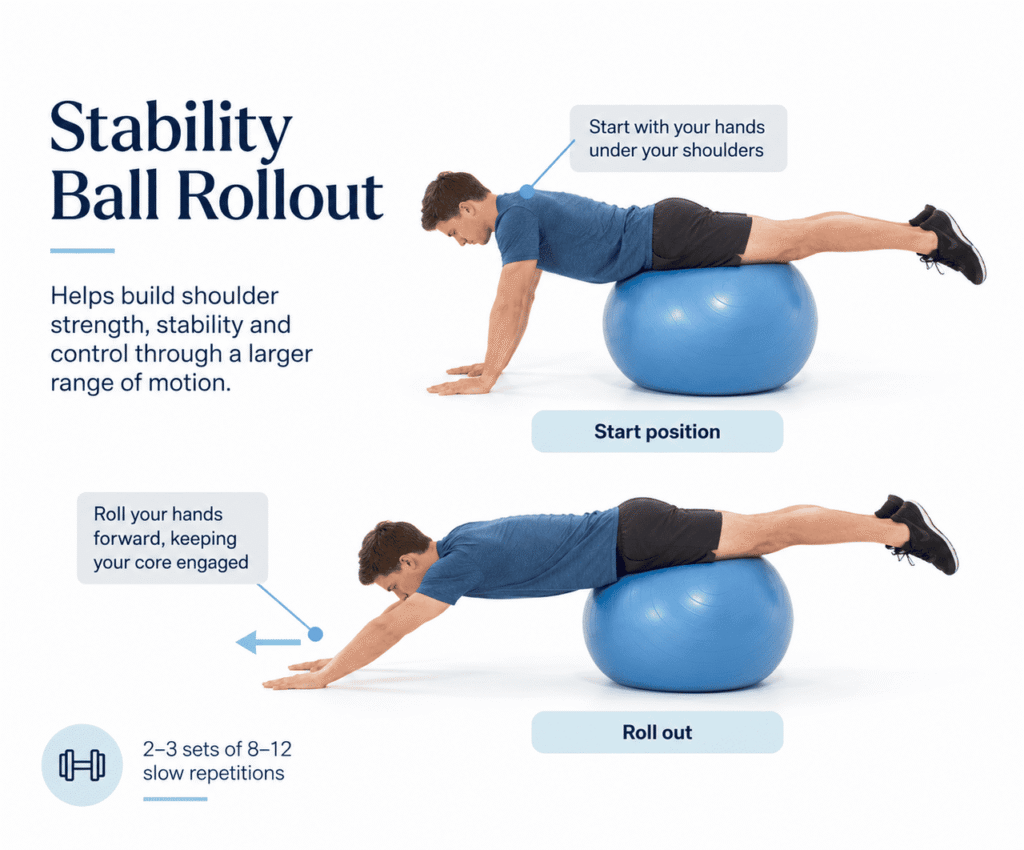
Once the shoulder tolerates initial strengthening, we can introduce exercises that challenge the scapular muscles under greater load. One example is a high-plank rollback using a stability ball.
With your hands supported on the ball, establish a controlled plank position. Slowly allow the ball to roll forward, increasing shoulder elevation while maintaining control through your shoulders and trunk. Then return to the starting position.
As the arms move farther overhead, the serratus anterior works with the trapezius to contribute to scapular upward rotation and control, while the rotator cuff helps stabilize the glenohumeral joint. This is different from simply pushing the shoulder blades forward in a serratus punch. The rollback challenges the shoulder complex while the arms move into greater elevation under load, combining scapular control, rotator cuff function and trunk stability.
Because this is a demanding exercise, it isn’t usually where we start with someone who has significant pain or difficulty lifting their arm. It’s a progression for a shoulder that is ready for greater loading, particularly when returning to more challenging upper-body activities.
For some people, the next step may be a landmine press or another form of resisted overhead movement, depending on their goals.
Why Progressive Loading Matters for Rotator Cuff Recovery
One of the most important principles in tendon rehabilitation is that tendons respond to mechanical loading. The rotator cuff tendons need sufficient loading to maintain and develop their capacity, but suddenly asking a sensitive shoulder to tolerate substantially more than it is accustomed to may aggravate symptoms.
This is where exercise dosage becomes important. If someone has avoided using their shoulder for several weeks because it hurts, they may have lost strength and confidence with movement. Returning immediately to heavy overhead exercise, however, may be more than the shoulder can currently tolerate. Rehabilitation involves finding an appropriate starting point and progressively increasing the challenge.
For one person, that might begin with gentle external rotation isometrics and wall slides. Another person may be ready for resisted shoulder elevation, heavier external rotation and more demanding exercises from the beginning. Contemporary tendon rehabilitation emphasizes progressive loading, but we should be careful not to assume that all rotator cuff-related shoulder pain represents a tendon problem or that one loading protocol suits everyone.
The 2025 rotator cuff tendinopathy guideline supports active exercise while acknowledging uncertainty about the optimal resistance, dosage and exercise selection. This means we need to assess how the shoulder responds and adjust the program accordingly.
Some discomfort during exercise can be acceptable. What matters is whether symptoms remain manageable and whether the shoulder settles afterward. If an exercise repeatedly increases night pain, produces significant next-day aggravation or makes everyday activities more difficult, we may need to reduce the resistance, range, volume or frequency.
Over time, improving strength and movement tolerance may help reduce symptoms during everyday activities and at rest. For someone who struggles to reach into a cupboard, lift groceries or put on a jacket, restoring the ability to perform those tasks can make a meaningful difference to their overall pain experience.
Better shoulder function may also contribute to better sleep, although the relationship isn’t as simple as performing a few wall slides and immediately sleeping through the night. Night pain can be influenced by several factors, and persistent symptoms shouldn’t automatically be attributed to weakness or poor scapular mechanics.
The important point is that we’re treating more than the discomfort of lying in bed. We’re helping the shoulder become more capable throughout the day.
The Avenue Perspective
When someone comes to Avenue Physio because their shoulder hurts at night, we certainly want to help them sleep more comfortably. But we also want to understand why their shoulder is painful and what needs to change for longer-term improvement.
The rotator cuff has a demanding job. It helps control a highly mobile joint while working alongside the deltoid, serratus anterior, trapezius and other muscles that coordinate shoulder movement. The scapula is an essential part of that system, and its ability to upwardly rotate during arm elevation can influence how the shoulder functions.
At the same time, we don’t assume that everyone needs the same movement correction. Not all shoulder pain is caused by the rotator cuff, and symptoms can also arise from frozen shoulder, arthritis, cervical nerve involvement or other conditions. A thorough assessment helps us identify what is contributing to the problem and which exercises are appropriate.
At Avenue Physio, we assess shoulder mobility, rotator cuff strength, scapular movement and how symptoms respond to different movements and loads. We may explore whether assisting scapular upward rotation makes reaching more comfortable, whether isometric loading is tolerated, or whether changing the angle or resistance of an exercise improves symptoms.
We also consider what the shoulder needs to do outside the clinic. Someone who works at a desk may have very different physical demands from a carpenter, swimmer or recreational weightlifter. Our goal is to identify an appropriate starting point, measure progress and develop a plan that restores strength and function.
For some people, that begins with a gentle isometric contraction. For others, a wall slide provides a more comfortable way to reach overhead. As rehabilitation progresses, the exercises become more challenging and more closely resemble the demands of everyday life.
The goal isn’t simply to activate a muscle or correct a movement pattern. It’s to build a stronger, more capable shoulder.
Better nights may be one of the benefits, but better shoulder function is the bigger objective.
If shoulder pain follows a significant fall or injury, particularly with sudden weakness or inability to lift the arm, seek prompt assessment. Progressive loss of movement, unexplained systemic symptoms or persistent worsening pain also deserve medical attention.
You can learn more about the shoulder conditions we treat, including rotator cuff tendinopathy, or read our article on physiotherapy for rotator cuff recovery.
At Avenue Physio, our one-on-one physiotherapy sessions give us the time to assess your shoulder, explain what we find and develop an exercise program specific to your needs.
Learn more about physiotherapy for shoulder pain in downtown Calgary.
Frequently Asked Questions
Should I exercise my rotator cuff if it hurts at night?
Often, yes. Appropriately selected exercises are an important part of managing rotator cuff-related shoulder pain. The starting exercise and amount of resistance should reflect your symptoms, strength and movement tolerance. Severe or worsening symptoms should be assessed rather than managed with a generic exercise program.
Do wall slides help rotator cuff pain?
Wall slides encourage coordinated shoulder elevation and scapular upward rotation. They can be helpful when supported movement makes reaching more comfortable, but they aren’t necessary or effective for everyone. A physiotherapist can determine whether they are appropriate for your shoulder.
Are isometric exercises better for rotator cuff tendinopathy?
Not necessarily. Isometrics can provide a useful starting point when movement is painful, but research has not shown that they consistently outperform exercises involving movement. Both can be incorporated into a progressive strengthening program.
How long does rotator cuff rehabilitation take?
Recovery varies depending on the condition, how long symptoms have been present, current strength and activity demands. Many programs progress over several weeks to months, with adjustments based on changes in pain, movement, strength and function. Persistent night pain or difficulty lifting the arm warrants assessment to confirm the diagnosis and guide treatment.