Why Does My Shoulder Hurt After Sleeping?

Why Does My Shoulder Hurt After Sleeping?

You wake up, roll over, and suddenly your shoulder hurts. By the time you’ve had a shower and moved around for a while, it starts to ease off. It’s a frustrating pattern, and one we hear about every week at Avenue Physio.

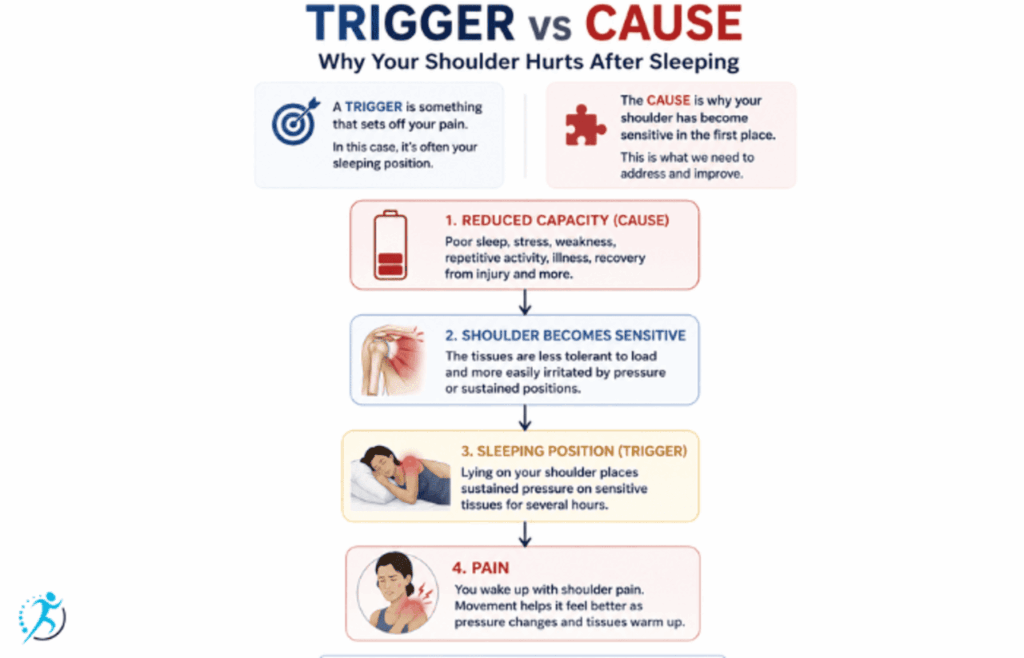
Most people assume they “slept on it wrong.” While it can certainly feel that way, sleeping rarely creates the problem. It usually reveals a shoulder that has already become sensitive to compression, prolonged positions, or the demands placed on it over the previous days or weeks.

The good news? Once you understand why it’s happening, it becomes much easier to fix.

Did I Sleep on It Wrong?

This is one of the biggest myths about shoulder pain.

For most people, the position you slept in wasn’t the cause of the problem. It simply revealed it.

During the day, your shoulder is constantly changing position. Blood flow changes, muscles switch on and off, and pressure shifts from one part of the shoulder to another. At night, your shoulder may stay in a similar position for several hours. If your shoulder has already become more sensitive or its tolerance to load has been reduced, that prolonged compression or sustained position can be enough to trigger pain.

In other words, sleeping didn’t create the problem. It simply exposed a shoulder that was already struggling to tolerate the demands being placed on it.

The sleeping position is often the trigger, not the cause.

Why Does It Hurt More After Sleeping?

Several normal changes occur while we sleep that can make an already sensitive shoulder more painful.

  • Your shoulder stays in the same position for several hours with very little movement.
  • Pressure on structures such as the rotator cuff or bursa is sustained rather than constantly changing.
  • The muscles that normally support and stabilize your shoulder are working differently than they do during the day.
  • Joints and soft tissues naturally become stiffer after prolonged rest.
  • After several hours without movement, the nervous system can become more protective, making the shoulder feel more painful when you first wake up.

This is why many people find their shoulder is at its worst first thing in the morning but gradually becomes more comfortable as they start moving.

That doesn’t necessarily mean you’ve “worked the problem out.” More likely, movement has reduced sensitivity, redistributed load through the shoulder, and reminded your nervous system that the joint can move safely again.

pain in shoulder after sleeping

Why Has My Shoulder Become More Sensitive?

Most people assume shoulder pain means something has been damaged. While that can happen after a significant injury, most shoulder pain develops gradually as the shoulder becomes less tolerant to the demands placed on it.

At Avenue Physio, we often explain this using a simple concept: capacity versus demand.

Think of your shoulder as having a “battery.” Every day, that battery is either being charged or drained.

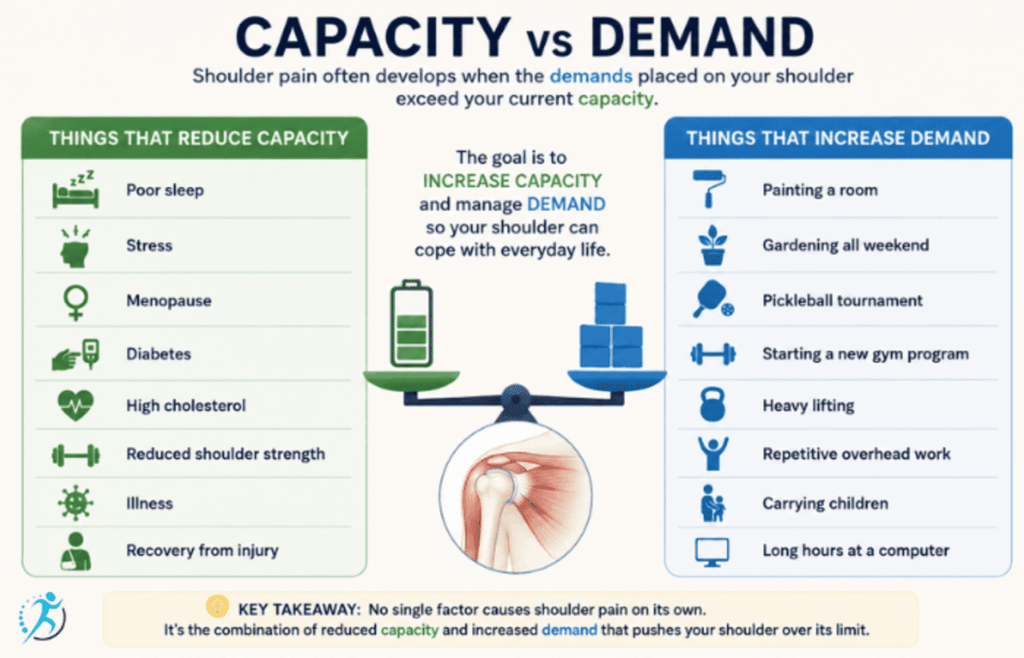
Your shoulder’s capacity is like the battery level. It’s the amount of load your shoulder can comfortably tolerate. That capacity is constantly changing. It can increase as you become stronger, move regularly, sleep well, and recover appropriately. It can also decrease during periods of reduced activity, illness, stress, poor sleep, hormonal changes, or repetitive overuse.

At the same time, the demands placed on your shoulder change from day to day. Lifting weights, painting a ceiling, carrying children, gardening, playing pickleball, working long hours at a computer, or even sleeping in one position for several hours all place load on the shoulder.

Shoulder pain often develops when those demands exceed your current capacity. Sometimes that’s because you’ve suddenly done much more than usual. Other times, your activity hasn’t changed at all, but your shoulder’s capacity has gradually declined.

Initially, you might only notice a slight ache after activity. As this mismatch continues, the shoulder becomes increasingly sensitive. Eventually, even everyday activities; including reaching into a cupboard, carrying groceries, or lying in bed, can become uncomfortable.

The goal of physiotherapy isn’t simply to reduce pain. It’s to improve your shoulder’s capacity so it can comfortably tolerate the demands of everyday life again.

Factors That Influence Capacity and Demand

sleeping shoulder pain

No single factor causes shoulder pain on its own. More often, it’s the combination of reduced capacity and increased demand that eventually pushes the shoulder beyond what it can comfortably tolerate.

Why This Matters

Understanding capacity versus demand changes how we approach treatment.

Instead of simply trying to reduce pain, our goal is to increase your shoulder’s capacity. That means improving strength, endurance, movement quality, and gradually exposing your shoulder to the activities it needs to tolerate: from reaching overhead and lifting groceries to sleeping comfortably through the night.

The encouraging news is that both your shoulder tissues and your nervous system are highly adaptable. With the right amount of movement and progressive loading, the shoulder becomes stronger, less sensitive, and better able to handle the demands of everyday life.

That’s why physiotherapy isn’t just about helping you feel better today. It’s about building a shoulder that’s resilient enough to keep you moving comfortably tomorrow, next month, and for years to come.

Can Sleeping on Your Side Cause Shoulder Pain?

The short answer is yes, but usually not for the reason people think.

Sleeping on your side doesn’t normally injure a healthy shoulder. However, if your shoulder has already become sensitive or its capacity has been reduced, lying on it for several hours can place enough sustained pressure on the tissues to provoke pain.

When you lie on your side, your body weight compresses structures such as the rotator cuff tendons and the bursa. In a healthy, resilient shoulder, these tissues tolerate that compression without any problem. But if the shoulder has become more sensitive because of repetitive activity, reduced strength, poor sleep, stress, or an increase in workload, the same position may become uncomfortable.

It’s also common to feel pain when sleeping on your non-painful side. Many people let their top arm hang unsupported in front of them, placing a prolonged stretch and load through the painful shoulder. Supporting that arm with a pillow can often reduce symptoms by decreasing the amount of sustained tension on the shoulder.

This is another example of capacity versus demand. Sleeping on your side isn’t necessarily harmful. It simply places a demand on the shoulder. If that demand exceeds what your shoulder can currently tolerate, pain is the body’s way of asking you to change position.

The goal isn’t to avoid side sleeping forever. It’s to gradually improve your shoulder’s capacity so it can comfortably tolerate sleeping in different positions again.

Best Sleeping Positions for Shoulder Pain

There isn’t one perfect sleeping position for everyone, but the goal is always the same: reduce sustained pressure and support the shoulder so it doesn’t have to work as hard while you sleep.

Sleeping on Your Back

For many people, sleeping on your back is the most comfortable position.

Place a pillow under your forearm or elbow so your arm is slightly supported away from your body. This reduces the amount of downward pull on the shoulder and allows the muscles around the joint to relax more comfortably.

Avoid letting your arm rest above your head or hang unsupported off the side of the bed.

Sleeping on Your Non-Painful Side

If you prefer sleeping on your side, lie on the shoulder that isn’t painful.

Place a pillow in front of you and rest your painful arm on top of it, as though you’re giving the pillow a gentle hug. Supporting the arm helps reduce prolonged tension through the rotator cuff and surrounding muscles.

Try to keep your elbow slightly in front of your body rather than tucked tightly against your side or reaching overhead.

pain in shoulder while sleeping

If You Sleep on the Painful Shoulder

Many people naturally roll onto their painful shoulder during the night.

If this position immediately increases your pain or repeatedly wakes you up, it’s worth modifying your sleeping position while your shoulder settles down. This isn’t because sleeping on that shoulder is causing damage. It’s simply placing more compression on tissues that have become sensitive.

As your shoulder’s capacity improves, most people are able to return to sleeping comfortably on that side.

Small Changes Can Make a Big Difference

Sometimes it’s not about changing your favourite sleeping position completely. Small adjustments, such as supporting your arm with a pillow or avoiding positions that place the arm overhead for long periods, can significantly reduce irritation overnight.

Remember, these strategies are designed to help you sleep more comfortably while your shoulder settles. They don’t replace strengthening, improving movement, or gradually increasing your shoulder’s capacity, the things that lead to long-term recovery.

When Should You See a Physiotherapist?

Many episodes of shoulder pain improve with a few simple changes, such as modifying your sleeping position, reducing activities that are aggravating the shoulder, and gradually returning to comfortable movement.

However, if your symptoms aren’t improving or are starting to affect your daily life, it’s worth having your shoulder assessed. The earlier we understand what’s driving your pain, the sooner we can help restore your shoulder’s capacity and prevent the problem from becoming more persistent.

Consider booking an assessment if:

  • Shoulder pain has lasted longer than 2 weeks without improving.
  • Your sleep is regularly disrupted by shoulder pain.
  • You’re losing shoulder movement or finding it difficult to reach overhead or behind your back.
  • Your shoulder feels weak or everyday activities such as dressing, lifting, or carrying have become difficult.
  • The pain keeps returning whenever you become more active.
  • You’re unsure whether your symptoms are coming from your shoulder, neck, or somewhere else.

If your pain started after a significant fall or injury, or you’re unable to lift your arm, seek medical assessment promptly to rule out a more serious injury.

At Avenue Physio, we’ll identify what’s contributing to your shoulder pain, explain why it’s happening, and develop a treatment plan that’s tailored to your goals. Rather than simply treating your symptoms, we’ll help build your shoulder’s strength, movement, and resilience so you can get back to sleeping comfortably and doing the activities you enjoy.

Frequently Asked Questions

Why does my shoulder hurt after sleeping?

Shoulder pain after sleeping is usually a sign that your shoulder has become sensitive to sustained positions or compression rather than a new injury. If the demands placed on your shoulder exceed its current capacity, lying in one position for several hours can be enough to trigger pain.

Why does my shoulder hurt more in the morning?

During sleep, your shoulder stays in one position for several hours with very little movement. This can increase compression, stiffness, and sensitivity. Once you start moving, pressure is redistributed, muscles become active again, and the shoulder often feels more comfortable.

What is the best sleeping position for shoulder pain?

Many people find sleeping on their back with a pillow supporting the arm, or on their non-painful side while hugging a pillow, is the most comfortable. The goal is to reduce pressure while your shoulder settles. Not to avoid certain sleeping positions forever. As your shoulder becomes stronger and less sensitive, most people can comfortably return to their preferred sleeping position.

Will shoulder pain go away on its own?

Some episodes of shoulder pain improve with time, activity modification, and gradual movement. However, if your pain has lasted more than a few weeks, is affecting your sleep, or you’re losing strength or movement, it’s worth having your shoulder assessed so the underlying problem can be addressed.